Thursday 1st April

1. Nice blog post from Claire Dembry of Cambridge English on using ‘Saylists’ in class here https://www.cambridge.org/elt/blog/2021/03/29/saylists-elt-classroom/ Saylist playlists are an Apple thing and they focus on songs which emphasise a single sound for practice purposes; here’s the <ch> one https://music.apple.com/gb/playlist/ch-saylists/pl.0b532ab630eb4e4689bfbb47bf4062d3 I’m not quite sure whether you need to subscribe to Apple Music to access them – my phone and laptop won’t let me pretend I’m not subscribed! Scroll down after you’ve read Claire’s Saylists piece for other Cambridge English blog posts at the bottom of the page.

2. The students in my own classes (a very long time ago) were never ever sleepy, nor was their teacher very often. I’m sure that’s true of your classes, too! Just in case, though, here’s a lesson from this week’s TeachingEnglish newsletter designed to wake up a sleepy class https://www.teachingenglish.org.uk/article/arm-exercises-speaking-activity-wake-a-sleepy-class

If you’d like to get your own copy of the fortnightly TeachingEnglish newsletter, you can subscribe here: https://www.teachingenglish.org.uk/subscribe-our-newsletter

3. If evaluation is your bag, you’ll find this report on Outcome Mapping interesting https://www.outcomemapping.ca/download/en_20%20years%20of%20OM.pdf And even if evaluation is definitely NOT your bag, read the summary on page 2 of the three principles, four concepts and five practices that underpin the outcome mapping philosophy. PDF below.

4. And, finally, Coventry is UK City of Culture for 2021-22, starting from mid-May https://coventry2021.co.uk/ A new city every four years, and last time round it was Hull. Coventry and Hull are linked by Philip Larkin: he was born in the former, worked for many years in the latter, and was often rude about both. On first arrival in Hull, he declared it “a ghastly place, as bad as Coventry” but later warmed to the city and described it as a place that people “are slow to leave and quick to return to”  https://coventry2021.co.uk/blogs/world-poetry-day-philip-larkin-in-coventry/

We have a long weekend off for Easter here in the UK – hurrah! – so my next message will be on Tuesday 6th April. Stay well and safe everyone.

Posted in Uncategorized | Leave a comment

Wednesday 31st March

1. Here’s a Think Like a Plastic Detective project and competition from National Geographic Learning, plus a video-recording of the related webinar that escaped my attention (but not that of 1,500 other people) last week: https://www.ngl-emea.com/projectexploration PDFs of both info sheet and teacher letter attached below for ease of reference.

2. A piece of provocation from a governor at a Bristol primary school https://capx.co/time-for-britains-outdated-school-system-to-embrace-the-digital-revolution/ which rang true for me, as a recent convert to WhatsApp voice messages, when the author talked of witnessing “first-hand the utility of voice feedback to pupils on work which can be replayed to parents at home instead of having to decode a litany of scribblings in a child’s exercise book”.

3. At 13:30 UK time tomorrow, Thursday 1st April, you might like to join Andreas Schleicher, OECD Director for Education and Skills, as he presents “the findings of a survey of around 30 different education systems and their responses to the pandemic, looking at how strategies varied across countries, whether or not certain strategies were favoured, and what the impact of these strategies was”. More info and registration here: https://meetoecd1.zoom.us/webinar/register/WN_mVlDgRubT0GfZLH9RTaBMQ

4. Two from the Gastro Obscura website https://www.atlasobscura.com/gastro: storing grapes in Afghanistan https://www.atlasobscura.com/articles/how-did-people-store-fruit-before-fridges and baking cakes in Bangkok https://www.atlasobscura.com/articles/siamese-portuguese-cupcake-recipe

5. And, finally, this week’s phobia, esperidoeidiphobia, is possibly one shared by fans of Jeanette Winterson’s (wonderful) first novel ….

Posted in Uncategorized | Leave a comment

Tuesday 30th March

1. I thought this blog post by Maha Bali, Students Talk to Me About Webcams, was an exemplary, really interesting piece of co-authorship by a teacher and her students: https://blog.mahabali.me/educational-technology-2/students-talk-to-me-about-webcams/

2. Malgorithm is a good neologism, I reckon. It’s the title of a report by the Center for Countering Digital Hate (CCDH) https://www.counterhate.com/ on how social media does not only not do a very good job limiting the spread of misinformation, its algorithms actually recommend posts they’ve labelled as misinformation. There are several good short introductory news videos on CCDH’s home page which would work well with older students. Link to report here https://252f2edd-1c8b-49f5-9bb2-cb57bb47e4ba.filesusr.com/ugd/f4d9b9_89ed644926aa4477a442b55afbeac00e.pdf and PDF below.

3. Plenty of notice for this free Lancaster University MOOC on FutureLearn: Dyslexia and Foreign Language Teaching https://www.futurelearn.com/courses/dyslexia/7 Next ‘edition’ starts on 19th April and comes very highly recommended.

4. Two quick reminders of approaching conference deadlines: first, the NATESOL annual conference https://natesol.wordpress.com/annual-conference-2021/ for which the deadline for submissions is 2nd April; second, Trinity’s Future of ELT conference for which the deadline for submissions is 6th April https://learn.trinitycollege.co.uk/foelt/events/2020

5. And, finally, I mentioned Richard Smith’s ELTJ article, A brief history of ELT Journal, yesterday. In response to popular demand, here’s a PDF!

Posted in Uncategorized | Leave a comment

Monday 29th March

1. Many of the readers of these messages of mine are indebted in one way or another to A S Hornby. Some of you have benefited from MA scholarships and some have attended summer schools and workshops funded by the A S Hornby Educational Trust – and pretty much everybody has used one edition or another of the Hornby dictionary, the Oxford Advanced Learners Dictionary, in their learning and teaching! The English Language Teaching Journal (ELTJ) have just made available a range of resources, many of which, including a facsimile of A S Hornby’s very first issue back in October 1946 and an interview with Hornby himself, are gathered together here https://academic.oup.com/eltj/pages/anniversary

And on this page https://academic.oup.com/eltj/pages/editors_choice_videos you can find a number of ‘Editor’s Choice’ videos where authors talk about their ELTJ articles, including one with Richard Smith talking about his article, ‘A brief history of ELT Journal‘. Thanks to Richard for bringing these resources to my attention!

I couldn’t find a download of the whole issue, but I’ve attached a PDF of Hornby’s editorial from Issue 1 on Foreign Language Studies: Their Place in the National Life.

2. The BAAL Language in African Special Interest Group will be holding their conference online this year, between the 1st and 14th of June 2021, on the theme of African languages and social change: Politics, activism, and justice. The conference will be free, and registration will open in early May; the main reason for my mentioning it now, though, is because the abstract submission deadline is the 16th of April 2021. BAAL are offering Internet Scholarships to assist participants who may be otherwise unable to attend due to high internet costs. If you would like to apply for an Internet Scholarship, please note this when submitting your abstract. PDF with full information attached below. (I wonder whether the English language is the elephant in this conference’s living room?)

3. UNESCO is conducting a short survey to collect data from parents of K-12 students on screen time, and its impact on children during the COVID-19 disruption, to help them provide informed recommendations on regulating home-based digital learning, better provision of digital learning materials, and protecting children from potential negative impacts. Survey link and more information here https://survey.alchemer.com/s3/6256737/Survey-on-Home-based-screen-time-digital-learning-and-digital-reading It takes around 15 minutes to complete and closes on Friday, 9th April. One of the areas the survey aims to collect data and feedback on is the costs and affordability of home-based digital learning. (I don’t see why teachers shouldn’t also respond.)

4. On a related matter, on Wednesday 31st July at 15:00 UK time OECD are organising a webinar on Understanding digital risks for 21st century children. More info and a registration link here https://meetoecd1.zoom.us/webinar/register/WN_n2aq76prR7SLlMKxJVniGg

5. And, finally, I strongly recommend a visit to https://storyhaven.digitalfiction.co.uk/wp-content/uploads/2020/11/Episode-1.html

Posted in Uncategorized | Leave a comment

Friday 26th March

1. David Malpass is the President of the World Bank Group, which makes him an important person in all our futures, I guess. He’s giving a talk for the LSE at 17:30 UK time on Monday, 29th March on Tackling the COVID-19 Pandemic of Inequality to Build a Green, Inclusive, & Resilient Recovery https://www.lse.ac.uk/Events/2021/03/202103291730/recovery I know nothing of Mr Malpass, but I’d love to think he’s a man of vision, passion and humanity – we can find out on Monday!

2. Pauline Rose of the Research for Equitable Access and Learning (REAL) Centre here in Cambridge has just published a report on Exploring the School to Work Transition for Adolescent Girls, which begins “If countries are to grow and prosper in a way that improves the lives of everyone, they need to make a special commitment to supporting one of the most vulnerable sections of the population: marginalised adolescent girls”.

Here’s a handy summary https://www.educ.cam.ac.uk/facultyweb_content/news/left-behind-adolescent-women-must-be-prioritised Download link here https://www.educ.cam.ac.uk/centres/real/publications/School%20to%20Work%20Transition%20for%20Adolescent%20Girls%20Full%20Report.pdf and PDF attached below.

3. Is the lecture dead? This article’s answer to that question would seem to be yes, more or less! https://www.aare.edu.au/blog/?p=8377

4. I thought this was rather good: https://www.artexchange.org.uk/artworks/hetain-patel-dont-look-at-the-finger/

5. And, finally, the latest Marsm playlist, this time of Sudanese music, curated by the London-resident Sudanese creative artist Basma Khalifa https://soundcloud.com/marsm-info/marsm-mixtape-3-by-basma and here’s a link to the most recent of Basma’s own monthly shows on NTS Radio (which I’ve just discovered) https://www.nts.live/shows/basma/episodes/khartoum-arrivals-w-basma-7th-march-2021

Posted in Uncategorized | Leave a comment

Thursday 25th March

1. Time to catch up with the Pearson ELT podcast: https://www.pearson.com/english/about/podcast.html Since I last paid a visit, David Crystal and Jennifer Jenkins have both been interviewed, about English Conversation and English as a Lingua Franca, respectively. Lots of other good stuff with less well-known people, too!

2. One for your advanced students, possibly: two diametrically-opposed accounts of the same session of Prime Minister’s Questions (PMQs) in the House of Commons yesterday, one from The Spectator [“Sir Keir Starmer (ed. the leader of the opposition Labour Party) will want to forget today’s PMQs. And fast.”] https://www.spectator.co.uk/article/keir-starmer-morphed-into-ed-miliband-at-pmqs and the other from The Guardian [“No lie off limits for Boris Johnson.”] https://www.theguardian.com/politics/2021/mar/24/no-lie-off-limits-for-boris-johnson Spot the difference!

And here’s the recording, if you’d like to form your own view: https://youtu.be/CgRdLIBUs8g Where is the man’s comb?

3. This is a fun TED talk by Lýdia Machová on The secrets of learning a new language https://www.ted.com/talks/lydia_machova_the_secrets_of_learning_a_new_language/transcript Listen out 1’40” in for the ingenious method Lucas from Brazil uses to learn Russian! There’s a rolling transcript available with blue highlighting. (I just made up that term ‘rolling transcript’.)

And here’s the twenty most popular TED talks of 2020: https://www.ted.com/playlists/780/the_most_popular_talks_of_2020 Ever so slightly US-centric but we can forgive them that, can’t we?

4. And, finally, PEN Transmissions, English PEN’s online magazine, is well worth a visit every now and then. Here’s Kikuko Tsumura’s piece on making masks work, translated by Polly Barton: https://pentransmissions.com/2021/03/02/working-masks/ and here’s Bangladeshi refugee Spicy’s Story, as told by Omid Tofighian and Behrouz Boochani https://pentransmissions.com/2021/03/12/spicys-story/

Posted in Uncategorized | Leave a comment

Wednesday 24th March

1. Most – but not quite all – of our countries have been at one end or another of a colonial relationship with another country. This event next Tuesday, 30th March, at 18:30 UK time, Empires Past and Present: empire around 1900, is the third in a series of four being given by Odd Arne Westad (his sister is called Even), the Elihu Professor of History and Global Affairs at Yale University. Register here https://www.lse.ac.uk/Events/2021/03/202103301830/Empires-Past-and-Present-empire-around-1900

You can find recordings of the first, Empires Past & Present: the idea of empire, here https://youtu.be/P6jG9zMKB4w and the second, Empires Past and Present: empire around 1800, here https://youtu.be/mwTOai7hX0o

2. I had occasion recently to re-visit David Graddol’s two influential publications, The Future of English (1997) https://www.teachingenglish.org.uk/article/future-english and English Next (2006) https://www.teachingenglish.org.uk/article/english-next, as the British Council is currently reviewing how many of David’s predictions have come true.

One of David’s questions back in 1997 was “Will the spread of English lead to half of the world’s languages becoming extinct?” and in 2006, David observed that “Native-speaker norms are becoming less relevant as English becomes a component of basic education in many countries”. Right on both counts, perhaps?  PDF of both (or should that be ‘each’?) below.

3. The Education Endowment Foundation (EEF) have recently published Five recommendations on special education needs in mainstream schoolshttps://educationendowmentfoundation.org.uk/tools/guidance-reports/special-educational-needs-disabilities/ PDF of the recommendations summary in poster form below.

4. Have you ever wondered what Shakespeare looked like? We now think we know (but I think the author is a vegetarian) https://www.theguardian.com/culture/2021/mar/19/shakespeare-grave-effigy-believed-to-be-definitive-likeness

5. And, finally, two closely related phobias for this week, for all those perfectionists out there: atelophobia and atychiphobia

Posted in Uncategorized | Leave a comment

Tuesday 23rd March

1. While I was exploring the LSE website the other day, I came across the very clear, three-minute-long video on (the right-hand side of) this page explaining How the US Government Works: https://www.lse.ac.uk/lse-player and I’d been hoping to find a twin video on how the UK government works to go with it – but I haven’t found one yet. I’ll keep looking. Let me know if you know of one, please! How about asking your students to produce a similar video on how government works in your country?

2. This one’s a little technical, and you may like to skim the summary and conclusions sections. The latest Bell Foundation https://www.bell-foundation.org.uk/ research report, English as an Additional Language, Proficiency in English and rate of progression: Pupil, school and LA (local authority) variation, is the last in a series of four investigating the relationships between English as an Additional Language (EAL), Proficiency in English (PIE) and educational achievement at school. https://www.bell-foundation.org.uk/eal-programme/research/english-as-an-additional-language-proficiency-in-english-and-rate-of-progression-pupil-school-and-la-variation/ PDF attached below. One of the report’s findings is that funding is typically available – in the UK, at least – for half as long as is necessary.

It’s well worth exploring the resources available on the Bell Foundation site, which include Macbeth for beginner EAL students – there’s quite a lot to unpack in that choice of text for that group of learners, I think. You’ll need to register.

3. Jamie Duncan is presenting the next seminar in the Lancaster Literary Research Centre series, Researching Protest Literacies, at 13:00 UK time on Friday 26th March, on his research in the favelas of Rio de Janeiro and what happens when protest ‘gets in the way’ of one’s fieldwork. More details and registration here: https://www.eventbrite.co.uk/e/researching-protest-literacies-tickets-142844518801

4. And, finally, an experimental film mentioned by a colleague this morning, Koyaanisqatsi https://youtu.be/v6-K-arVl-U It’s all about balance – or the lack of it – between our own way of life and the rest of the natural world. Sound track by Philip Glass.

Posted in Uncategorized | Leave a comment

Monday 22nd March

1. TERN https://www.wearetern.org/ and Techfugees https://techfugees.com/ are organising an event on 25th and 26th March on Tech & Digital by and with Refugees. More info and registration here https://www.eventbrite.co.uk/e/tech-digital-with-and-by-refugees-an-event-by-tern-techfugees-tickets-142240991635 and you should feel free to pop in and out over the course of the event as the mood takes you.

2. A Day in the Life of Abed Salama is an engrossing ‘long read’ on life in Palestine from the New York Review of Books that I came across just after – typical! – I’d posted Friday’s message mentioning the event with teachers from Gaza this Wednesday. The article’s available without subscription for two weeks: https://www.nybooks.com/daily/2021/03/19/a-day-in-the-life-of-abed-salama/ And a quick reminder of the event on Wednesday: https://www.teachingenglish.org.uk/article/being-english-teachers-gaza

3. On Thursday 25th March at 18:00 UK time, Paul Dolan, the Professor of Behavioural Science at the London School of Economics and Political Science (LSE), will be in conversation with his colleague Grace Lordan about her new book, Think Big: Take Small Steps and Build the Future You Want, which draws ‘on cutting-edge research from behavioural science [and] offers immediate actionable solutions and tips that will help you get closer to your dream future’. Almost too good to be true? Let’s see! More info here https://www.lse.ac.uk/Events/2021/03/202103251800/Think-Big and a registration link here https://lse.zoom.us/webinar/register/WN_czRtfXzPRZS9cwPXXxInKg (And just why is the abbreviation ‘LSE’ and not ‘LSEPS’, I wonder?)

4. And, finally, In Our Time, chaired by Melvyn Bragg, is one of the very longest-running BBC Radio 4 shows, with a huge archive available on BBC Sounds to download or stream. To pick only three episodes from the nine hundred (!) currently available, try

photosynthesis

https://www.bbc.co.uk/programmes/b0435jyv

the Rosetta Stone

https://www.bbc.co.uk/programmes/m000s2qd

or Chairman Mao’s Cultural Revolution

https://www.bbc.co.uk/programmes/m000q9b6 for starters.

As a bonus, here’s the episode of Neil McGregor’s series, A History of the World in 100 Objects, on the Rosetta Stone https://www.bbc.co.uk/programmes/b00sbrz3 – there’s a transcript, if you’re tempted to turn it into a lesson.

Posted in Uncategorized | Leave a comment

Friday 19th March

1. ‘Being English Teachers in Gaza’: next Wednesday, 24th March, at 12:00 UK time, four teachers from Palestine – Diana Abu Zayed, Tasnim AlAsttal, Somia Rajab and Laila Saleh – will be reflecting on and discussing their professional identity as teachers in a panel discussion chaired by my colleague, Damian Ross. No teaching context is easy, but I guess some might be easier than Gaza. More info and a registration link here https://www.teachingenglish.org.uk/article/being-english-teachers-gaza

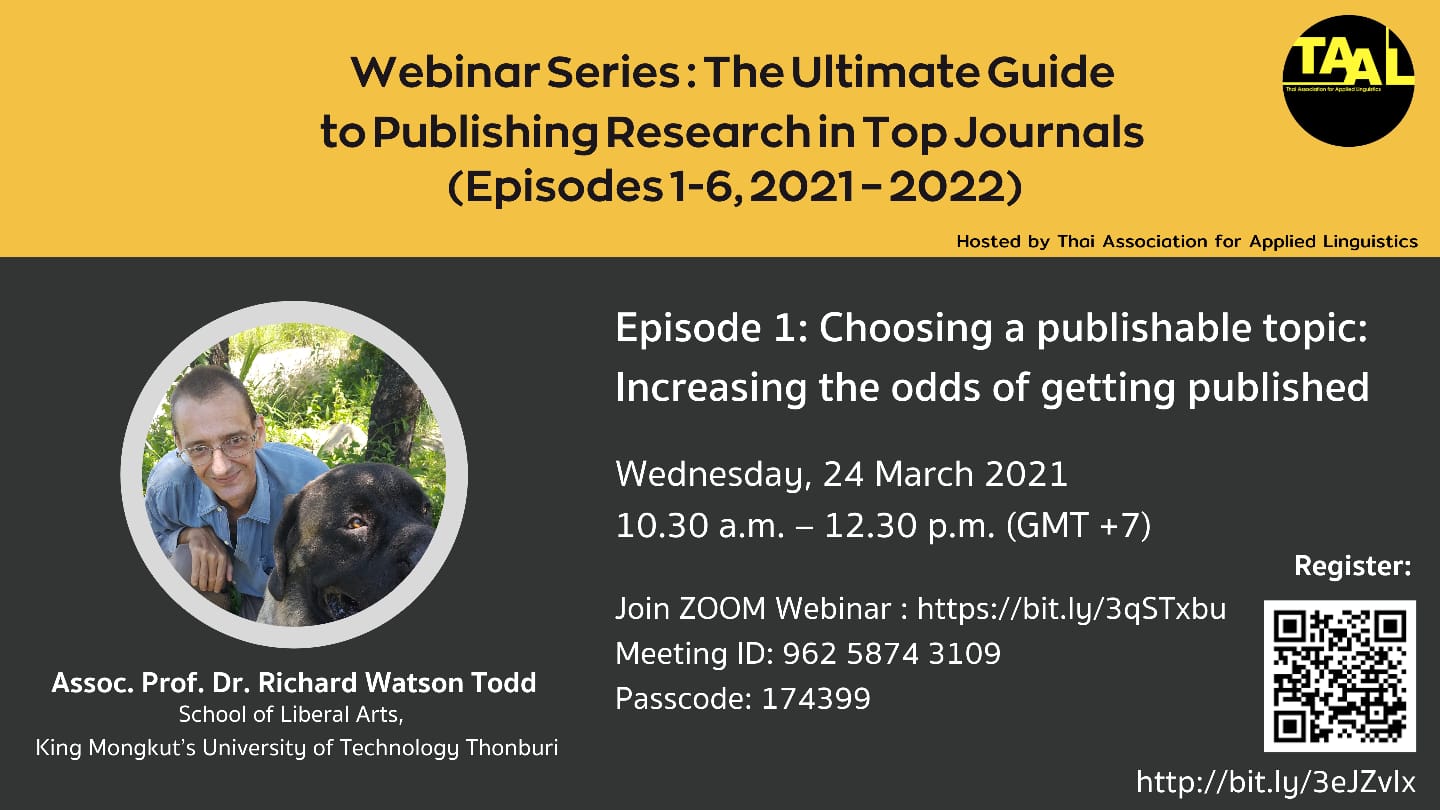
2. Also next Wednesday, 24th March, at 03:30 UK time – I’ve asked if there’ll be a recording! – the first in a series of six Thai Association of Applied Linguistics (TAAL) events which together make up ‘The Ultimate Guide to Publishing Research in Top Journals’Richard Watson Todd (plus one of his two amazingly large dogs in the photo attached below) on Choosing a Publishable Topic. Zoom link here  https://bit.ly/3qSTxbu and more info in the photo attachment below.

3. Third up today, a matching pair: a set of self-access guides to help teachers plan and shape their own professional development https://www.teachingenglish.org.uk/article/teaching-success-self-study-guides plus a booklet for teacher associations designed to help them help their members get the most out of the self-access guides https://www.teachingenglish.org.uk/article/teaching-success-self-study-booklets-a-guide-teacher-associations I’ve attached a PDF of the guide for teacher associations below.

4. McKinsey, the management consultants, usually charge governments round the world a very hefty sum for their services. Here’s an article from them for free, though, about a teacher survey they conducted recently which shows that learning loss due to Covid is global – and significant https://www.mckinsey.com/industries/public-and-social-sector/our-insights/teacher-survey-learning-loss-is-global-and-significant “Although teachers around the world have different styles and standards for learning, there is one thing on which they seem to agree: a computer is no match for a classroom as a place for kids to learn.” PDF attached below in case you have trouble with the download.

5. And, finally, Don Winslow is a favourite author of mine. I’ve just read the new one, Broken, and here’s Winslow talking about it https://youtu.be/uAwU3hpLrXE One thing that puzzled me in Broken, though, was his use of ‘ILYM’ at the end of the Acknowledgements. I know the very large majority of the readership of these messages is much younger and much funkier than me, but I had to look it up … https://www.cyberdefinitions.com/ (If you’ve not read any Winslow yet, try either The Force, about the New York Police Department, or the first book of his ‘Cartel’ trilogy, The Power of the Dog.)

Posted in Uncategorized | Leave a comment