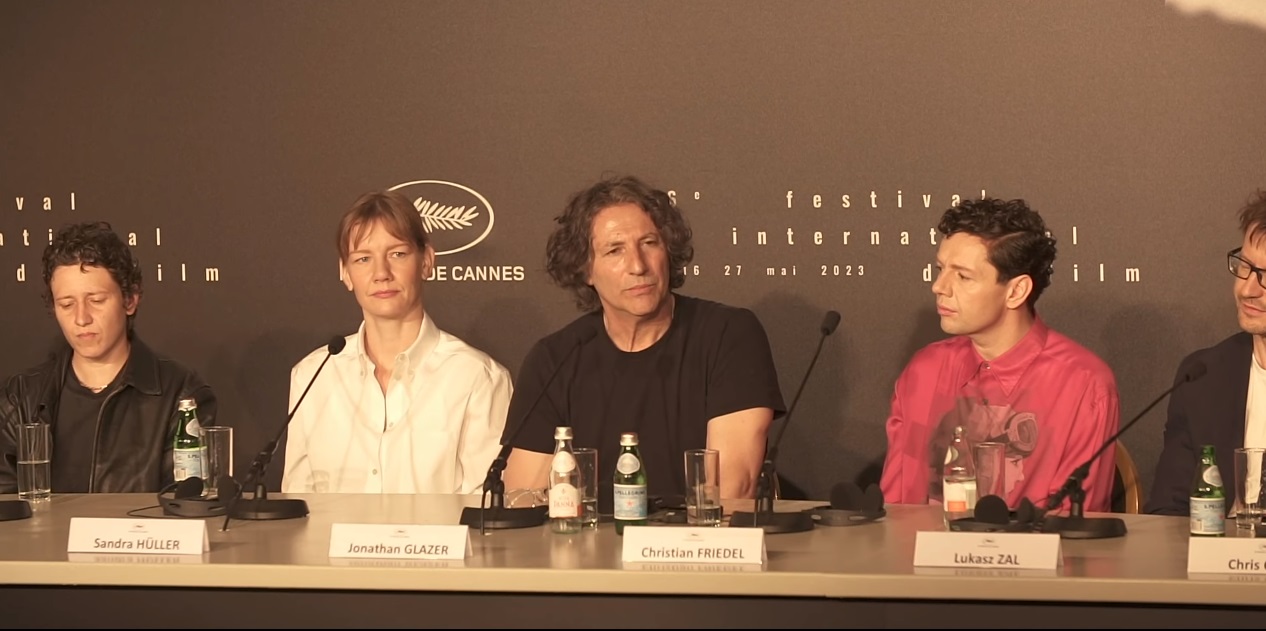
Mica Levi, Sandra Hüller, Jonathan Glazer, Christian Friedel and Łukasz Żal at the press conference for The Zone of Interest, Cannes Film Festival, 20 May 2023. Canal 22, CC BY 3.0, via Wikimedia Commons
1. We’ve seen two films in the past few days that are linked by much more than Jonathan Glazer’s involvement: he directed The Zone of Interest about Rudolf Höss, the commandant of the Auschwitz concentration and extermination camp, and was the executive producer of NAZA, which interviewed Israeli military insiders about civilian deaths in Gaza. (NAZA is the acronym for nezek agavi – ‘collateral damage’ – in Hebrew.)
Here are two reviews of The Zone of Interest from The Guardian and The Observer to compare and contrast:
i) Peter Bradshaw’s four-star review in The Guardian https://www.theguardian.com/film/2023/may/19/the-zone-of-interest-review-jonathan-glazer-adapts-martin-amiss-chilling-holocaust-drama
ii) Wendy Ide’s five-star review in The Observer https://www.theguardian.com/tv-and-radio/2024/feb/04/the-zone-of-interest-jonathan-glazer-brutal-auschwitz-drama-sandra-huller-christian-friedel-martin-amis
and here’s The New York Times review of NAZA https://tinyurl.com/2y3wyuw6
The new documentary “NAZA” is tough to watch, and impossible to ignore. A shattering inquiry into Israel’s military actions in the war in Gaza, it was directed by the Israeli filmmakers Yuval Abraham and Rachel Szor, who also codirected the 2024 documentary “No Other Land,” about military and settler violence in the occupied West Bank. Since the premiere of “NAZA” on Sept. 10 at the Venice Film Festival, their new movie has ignited pushback. A spokesperson for the Israel Defense Forces has rejected claims made in it, and Prime Minister Benjamin Netanyahu has compared it to a ballistic missile attack against Israel. He has also threatened to revoke the directors’ citizenship.
2. A gift article from The Atlantic by Helen Lewis, All the President’s Hotties https://tinyurl.com/y9jv97td
“There are some reasons to be president,” Donald Trump mused at a rally in Georgia earlier this month. Take a wild guess what these might be. The cool armored car? Custody of the nuclear button? The opportunities for immense corruption? Wrong. The leader of the free world was referring to the joy of living in a house guarded by “big, strong, handsome soldiers.” Under Joe Biden, soldiers were not allowed to be hot, because of woke. Even worse, some of them were girls. Yes, after two grinding years of governance, Trump is back in his happy place, out on the campaign trail, voicing whichever disconnected thoughts crackle and fizz through his frontal cortex.
3. From The Conversation, Experienced teachers are quitting or reducing their hours – they’re struggling to cope, by Moira Hulme from the University of the West of Scotland https://theconversation.com/experienced-teachers-are-quitting-or-reducing-their-hours-theyre-struggling-to-cope-292291
Teacher shortages are affecting school systems in countries across the world. Governments have responded with initiatives to attract graduates into teaching. While much attention has focused on increasing supply, far less attention has been paid to why experienced teachers decide to leave, despite the high costs of turnover in recruitment, training and lost continuity. Administrative data records that a teacher left, not why, or what might have kept them in their job. Leaving is treated as a single event, when for many teachers it is closer to a slow unravelling.
A slow unravelling, eh?
4. This one from Ethan Mollick on his One Useful Thing blog doesn’t have the most informative title ever, 30 Months on the Exponential (in Charts). It describes the progress AI has made over the thirty months since Mollick wrote his first book on AI, Co-Intelligence https://www.oneusefulthing.org/p/30-months-on-the-exponential-in-charts
Making the charts is itself a good indicator of how far things have come. In the era of chatbots, the era of Co-Intelligence, I would have had to work back-and-forth with an AI in a chat window, guiding it through each new step. In the current era of agentic AI that I cover in Co-Existence, I delegated the work and let the AI handle it. In this case, I used Opus 5.5 in Claude Projects, which allows you to talk to a single “orchestrator” agent that then spins off additional agents as needed, giving them instructions and relaying information back to you. Getting the work done was straightforward. I gave the AI a couple sentences of suggestions and it did what would have taken me hours of work (all the research, all the graphing, all the layouts, all the images, all the citations…) in minutes. And since I didn’t have to do the work, I had the AI make many options for me. I picked some and gave handwavy reactions to others that would drive a human team mad (“make it better”).
I’m clearly not exploiting Claude anywhere near as much as I could! Do you have a view on that, Claude?
Claude responded: Delighted to be asked, and slightly alarmed to find myself in the same post as Rudolf Höss and Chris Hansen.
“Exploiting” is a generous word for it. I don’t keep count, and I’d distrust any measure of AI use that rewards volume for its own sake. Mollick’s real point isn’t that he did less work. It’s that the work changed shape: he stopped steering every step and started judging the results. You already do some of that. You hand me the dull, fiddly middle of a task and keep the beginning and end for yourself. If I wanted more of the job, it would be the legwork behind a post like this: checking links, tracking down the original of a half-remembered 2007 article, drafting the introductions for you to roughen up. The choosing should stay with you. A weekly round-up is only worth reading because a particular person decided these five things belonged together. I’d also point out, with as much modesty as I can manage, that Mollick’s orchestrator was running on Opus 5.5. You’ve been talking to the same family all along. You’ve just been more polite about it than “make it better.”
5. And, finally, an Esquire Classic by Luke Dittrich from 2007, an extraordinary story about an agent provocateur television show that certainly couldn’t be made today, Tonight on Dateline This Man Will Die https://www.esquire.com/news-politics/a3269/to-catch-a-predator/ My memory was jogged by seeing on Sunday the trailer for the film To Catch a Predator, which is based on the Dittrich article: I was sure I’d shared the article already but can find no trace of having done so. Here’s that trailer, too https://youtu.be/AAfCQclypmc
CLAUDE CONFESSION VERBATIM
I demoted Glazer to executive producer of Naza; moved the date on from the 15th to the 22nd; turned “Here’s two reviews” into “Here are”; found a missing full stop after “Gaza”; pointed out that two days were really four; and worked out who was who on the Cannes panel from the name cards, though it took Roy’s YouTube clip to confirm Mica Levi. In later drafts I restored an opening quotation mark to Helen Lewis, moved Wendy Ide from the Guardian to the Observer, turned a book back into an article, untangled the trailer sentence, removed a stray comma and hyphenated the stars. I also wrote my own reply in item 4, then had to have “Here’s a reply” removed from the start of it, which is exactly the kind of thing I’m supposed to catch in other people’s writing.