Monday, 19th April

1. Never mind Brexit! Never mind Covid! What’s the biggest story in all the UK papers today and the first item on all the TV and radio news bulletins? Football! Specifically, the plans by twelve of the richest clubs to establish a European Super League to make themselves even richer. Here’s The Guardian’s account of what the President of UEFA calls “a disgraceful and self-serving proposal from clubs motivated by greed”: https://www.theguardian.com/football/2021/apr/19/super-league-players-face-world-cup-and-euros-ban-warns-furious-uefa-chief

Even Boris is getting involved https://www.theguardian.com/football/2021/apr/19/ministers-urged-to-take-action-over-european-super-league-plan

That second link includes a good short video explaining what all the fuss is about. Good material for a role play with club owners, managers, players, fans (and some people who can’t stand football)? https://www.teachingenglish.org.uk/article/role-play

2. Eclectic? I should cocoa! The Lancaster Literacy Research Centre programme covers topics ranging from Reading, Writing and Rebellion at 10:00 UK time this coming Friday, through a prosopographical (me neither!) look at Ancient Babylon, to the role of Minecraft in education research. Click on the booking link for each event for more info http://wp.lancs.ac.uk/literacy-research-centre/

3. And while we’re talking about Lancaster, a reminder that their MOOC on Dyslexia and Foreign Language Teaching starts today: https://www.futurelearn.com/courses/dyslexia/7

4. Thinking of becoming a head teacher? Read this OECD report first! https://www.oecd-ilibrary.org/education/what-are-the-roles-and-salaries-of-school-heads_97d6b7a5-en PDF below.

5. And, finally, how stressed should I be that I only discovered this morning that April is Stress Awareness Month every year? Maybe this test will help me find out https://www.stress.org.uk/individual-stress-test/

Posted in Uncategorized | Leave a comment

Friday, 16th April

1. This month’s edition of Humanising Language Teaching (HLT) from Pilgrims – no country focus this time round that I can detect but the usual rich and varied mixture of topics nonetheless! https://www.hltmag.co.uk/apr21/

2. Two considered pieces from The Conversation about the resurgence of violence in Northern Ireland, which many people think is an unintended consequence of Brexit:

https://theconversation.com/northern-ireland-the-politics-behind-the-riots-158727

https://theconversation.com/northern-ireland-how-to-understand-the-influence-of-paramilitary-groups-158726

Don’t ask me what were the intended consequences of Brexit, please.

3. Acronym alert! EAP is English for Academic Purposes, BALEAP is the British Association of Lecturers in English for Academic Purposes, and a SIG is a Special Interest Group. OK?

EAP for Social Justice is one of BALEAP’s SIGs, and they recently published this account by Bill Guariento of an online pre-sessional partnership between Science, Engineering and Technology students at the University of Glasgow and at the Islamic University of Gaza https://eap4socialjustice.net/2020/06/06/pre-sessional-english-language-courses-university-telecollaboration-as-a-driver-of-global-north-south-student-contact-for-engineers/

Bill’s paper “concludes that pre-sessional English language telecollaboration that juxtaposes areas of peace and conflict can offer particular opportunities for the dialogue that, in Freire’s view (1996: 69) leads, through action and reflection, to ‘naming’ – and thereby potentially changing – the world”. PDF below if that’s easier than a long scroll.

4. I missed this report by the Society for the Advancement of Education https://www.sahe.org.pk/ looking at Medium of Instruction in Punjab’s Government Schools when it was first published a year ago and have just come across it while doing some preliminary research for a new CLIL project https://www.teachingenglish.org.uk/sites/teacheng/files/Change_Medium_Instruction_Punjab_Government_Schools-Perceptions_Prospects.pdf

Its findings “point to the need for an appropriate language in education policy wherein Urdu rather than English serves as the MoI (medium of instruction) in the primary grades, English is taught more effectively as a subject or skill and there is room for the mother tongue to complement Urdu in the initial years”. It includes a very useful literature review. PDF below.

5. And, finally, my colleagues in Portugal have started a podcast, primarily for the students they teach – but I think it deserves a wider audience! https://spark.adobe.com/page/8xM4IHdgPtfZa/

In their own words, “The Sunshiny Day podcast is a tiny audio present packed with surprising talents, funny stories, moving music, side-splitting jokes, and much, much more!” Simple little gems like a nine-year-old talking about – and playing – their green ukulele (at the beginning of the first episode). How about you start one with your students?

Posted in Uncategorized | Leave a comment

Thursday 15th April

Lots of webinars today!

1.  On Monday, 19th April, at 14:00 UK time, Assessing teenagers online from OUP with Sarah Rogerson and Paul Davies https://www.facebook.com/oupeltglobal/ PDF of the ‘focus paper’ on the topic below. (Free to download, along with lots of others, once you’ve registered.)

2. At 15:00 UK time on Monday, 19th April, Princeton University open the symposium on ‘Language and Migration: Experience and Memory’ that they’re hosting in collaboration with the Study Group on Language and the United Nations. It’s free and open to the public, but you need to register. More information here https://migration.princeton.edu/symposium and registration link here https://princeton.zoom.us/webinar/register/WN_GNf33xbFR1O9wdsn38Hk6Q

Programme here https://migration.princeton.edu/symposium/program – scroll right down for some interesting creative writing events at the end, including Jhumpa Lahiri, Yiyun Li, Aleksandar Hemon and Viet Thanh Nguyen.

3. On Tuesday, 20th April, at 10:00 UK time The Centre for Language Education Research at Queen’s University Belfast are hosting a talk from Professor Jo Mynard from Kanda University of International Studies in Japan on “Supporting learners outside the language classroom: Theory and practice”. The facilitator will be Dr Sin-Wang Chong from Queen’s. More info and registration here: https://www.eventbrite.co.uk/e/seminar-series-dr-jo-mynard-supporting-learners-outside-the-classroom-tickets-147090015195

4. Thursday, 22nd April, is the ‘Teachers Day’ of English UK’s ELT Conference. (English UK was one of the partners in the PRELIM project, alongside IATEFL and the British Council.) Silvana Richardson and Chia Suan Chong will give the plenary talk, The native factor and the last five years, at 12:00 UK time, and Colm Downes, Christopher Graham and Dianna Toroysan will talk about Climate action in language education at 15:30 UK time.

Lots of other good stuff, too. Starts at 09:00 UK time. More info and registration here https://www.englishuk.com/elt-conference You need to register for the teachers’ day, but it’s free. Both plenaries will also be live streamed and more info on both of them here https://www.teachingenglish.org.uk/article/english-uk-english-language-teaching-conference

5. And, finally, but only if you’re not too squeamish, here’s the CrimeReads selection of the best true crime podcasts at the moment https://crimereads.com/9-true-crime-podcasts-to-listen-to-this-spring/

Posted in Uncategorized | Leave a comment

Wednesday 14th April

1. Chris Sowton is giving a webinar for TeachingEnglish at 12:00 UK time tomorrow, 15th April, on Teaching in Challenging Circumstances https://www.teachingenglish.org.uk/article/10-key-strategies-teaching-challenging-circumstances

which is also the title of the book that Chris published recently with Cambridge University Press. Here’s more info about the book on Chris’s own site https://www.chrissowton.com/ticc

2. In pursuit of their mission, ‘free thinking for the world’, openDemocracy ruffle governmental feathers globally https://www.opendemocracy.net/en/

Here’s a short film that George Monbiot produced for them recently, ‘It’s time to bail out the planet’, that might go down well in class, I think https://youtu.be/-0guuB34MKM Bail out the planet this time, says Mr Monbiot, not the banks!

3. Rangina Hamidi has, without doubt, one of the more challenging Minister of Education jobs around the world, in Afghanistan. Here’s an inspiring interview with her from Education Cannot Wait https://ecw.exposure.co/afghanistan-rangina-hamidi

4. Back by popular request, a bit more Bach from the Dunedin Consort and the Cambridge Music Festival https://youtu.be/-Q_d7zNgx34 Available from 18:00 UK time today!

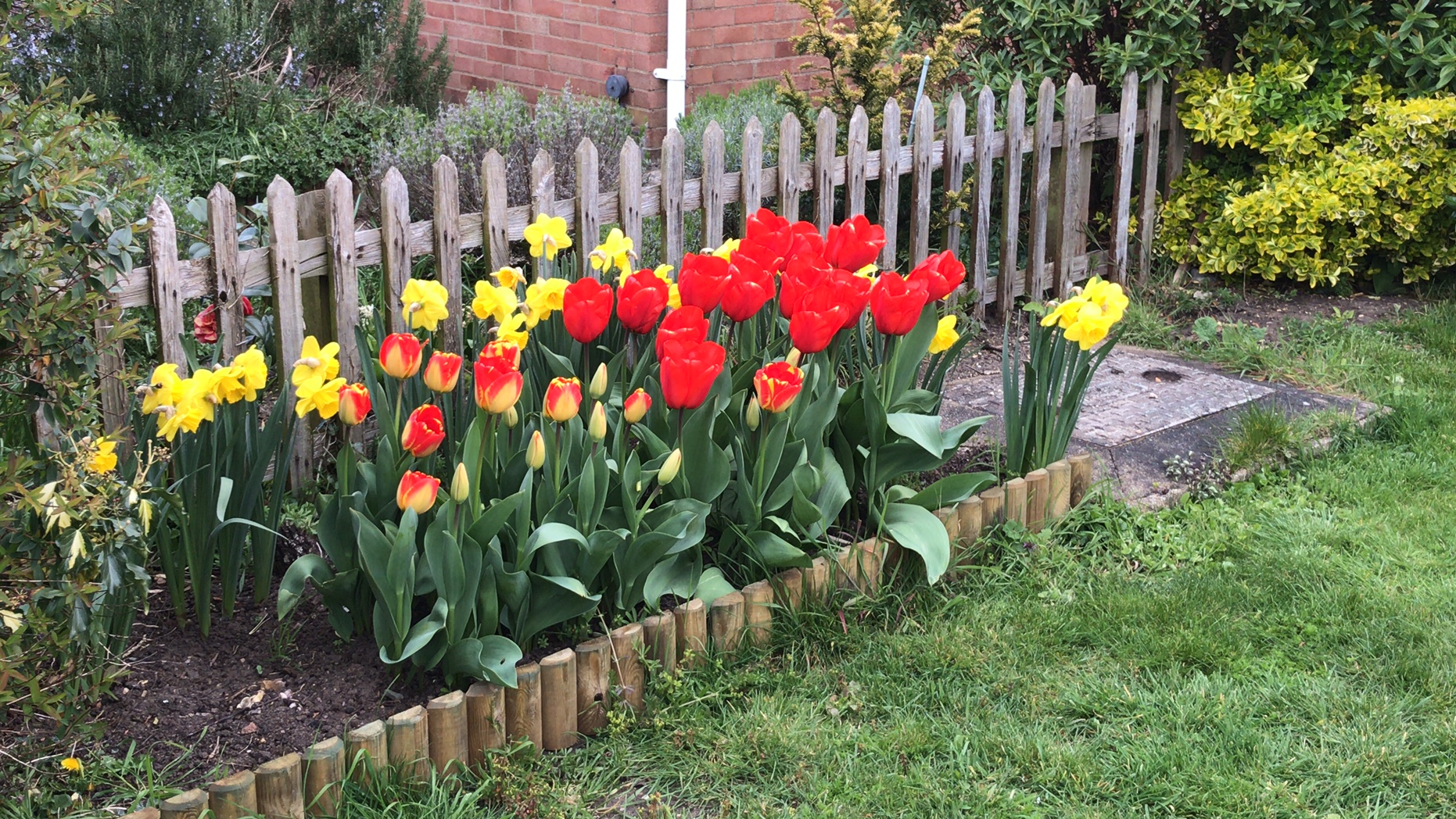
5. And, finally, this weeks’ phobia, anthophobia. If you suffer from it, do not look at the photo below that I took on my lunchtime walk today!

Posted in Uncategorized | Leave a comment

Tuesday 13th April

1. Three free Modern English Teacher articles here https://www.modernenglishteacher.com/ Scroll down the page a little: Dave Dodgson on Teacher Professional Development – keeping your own motivation going, Fiona Dunlop on Raising your profile and Jeffrey Dawala Wilang on A positive approach to (online) English language teaching.

2. I still haven’t quite worked out which bits of onestopenglish are free and which are not, but this section seems open free to all of us, if you’re registered: https://www.onestopenglish.com/teenagers/general-english/topics-and-themes

There’s a ‘digital skills’ lesson plan on avatars for teens here https://www.onestopenglish.com/topics-and-themes/digital-skills-for-teens-elementary-avatars/1000160.article which prompts the question don’t teens know more about avatars than we do? Maybe they don’t know it in English! PDFs of worksheet and lesson plan below.

3. This one’s a worryingly long link https://www.ucl.ac.uk/ioe/news-and-events/ioe-events?collection=drupal-ioe-events&meta_UclEventType=!%22Short+course%22&meta_UclOrgUnit=!%22IOE+Staff+Intranet%22&meta_UclOrgUnit=%22Institute+of+Education%22&&ge_DateFilter=20210413 but it should take you through to the University College London Institute of Education’s rich programme of online events.

There’s a conference on 19th April on working with struggling readers https://www.ucl.ac.uk/ioe/events/2021/apr/virtual-event-learning-talk-talking-learn-reading-recovery-national-conference and another on 22nd April on literacy in diverse contexts, life-long and life-wide https://www.ucl.ac.uk/ioe/events/2021/apr/virtual-event-literacies-through-life-reading-families-homes-and-communities

Well worth checking in to see what’s on every now and then!

4. And, finally, attached below, is what Prince Philip thought about long sermons!

Posted in Uncategorized | Leave a comment

Monday 12th April

1. As I’m sure most of you worked out, there was no message on Friday because Prince Philip died that morning, at the end of a very long and interesting life. Here’s The Guardian‘s long and interesting obituary: https://www.theguardian.com/uk-news/2021/apr/09/prince-philip-the-duke-of-edinburgh-obituary

“Things did not work out that badly,” says The Guardian, despite Philip’s initial belief “that a life of walking several steps behind his wife, curbing his opinions – though not always his tongue – and being an appendage to the institution, without even being able to pass on his surname to his children, would turn him into ‘nothing but a bloody amoeba’”.

2. This, from UNESCO, seems almost too good to be true, certainly less bureaucratic than one might (unfairly?) expect. They’ve just published a comprehensive report on Ensuring effective distance learning during COVID-19 disruption: guidance for teachers https://unesdoc.unesco.org/ark:/48223/pf0000375116 [PDF below] and they’re inviting applications for funding for events to help disseminate the report in a very straightforward manner with one simple form  https://survey.alchemer.com/s3/6276729/Call-for-proposals-Appel-propositions

Applications close on 15th April, and I wonder whether English teacher associations might like to apply (and be well placed to do so)?

 3. I follow up on a lot of the tips in Stephen Downes’s daily newsletter, OLDaily. Here’s his website https://downes.ca/ and here’s the link to subscribe https://downes.us18.list-manage.com/subscribe?u=0db1946a4fdb6209a60697e55&id=f461fc1560 His primary focus is on online learning and educational technology, but he often, interestingly, strays off the beaten track. His website has a Quick Tech Guide to Creating an Online Class or Conference that’s well worth a look https://docs.google.com/document/d/1ux3lTnUTpzZRuvxE3rAsSQ4Ihub96S8_OYECNh8wv-A/edit PDF below.

4. And, finally, here’s a golden oldie RSA animation of a Dan Pink talk on ‘Drive: the surprising truth about what motivates us’ https://www.youtube.com/watch?v=u6XAPnuFjJc If, like me, you’re a really sad person who can’t miss a typo, you’ll spot one – well, I spotted only one, albeit unwillingly. Let me know what typo and where and I’ll send you a copy of Philip Kerr’s Metropolis – I’m being encouraged to downsize my library!

Posted in Uncategorized | Leave a comment

Thursday 8th April

1. This recent piece of research by Strathclyde University into what they call composite classes – classes made up of children from more than one year group, as is still reasonably common in a number of countries round the world but far from the norm – in Scotland came to the interesting conclusion that “exposure to older peers is highly beneficial (my emphasis) to primary school pupils in terms of attainment. Composite classes, which are widespread internationally and very common in Scotland, explicitly create these peer effects while simultaneously allowing administrators to save classrooms and thus costs. Class size reductions, by contrast, offer no statistically significant benefits.” Link here https://strathcloud.sharefile.eu/share/view/s8afbaaf453134a51ba2651945940e76d and PDF below.

2. The EQUIP project https://ec.europa.eu/trustfundforafrica/region/horn-africa/sudan/education-quality-improvement-programme-sudan-equip-sudan_en works with one country, Sudan, in one continent, Africa, but the lessons learnt from it will resonate in many other countries where delivering innovative – or even non-innovative! – teacher training in remote contexts is a major challenge. The project team are sharing their research and the lessons they’ve learnt at a webinar at 10:00 UK time on 20th April. More info in the PDF below and a registration link here https://docs.google.com/forms/d/e/1FAIpQLScwrFE9U-4siDJTLhokMtzgaVFurMx2pgt0eDB0Fu2G7Q-P5A/viewform

3. Here’s another EU-funded project with resonance elsewhere in the world, European Language Equality: https://european-language-equality.eu/ Here’s a blunt summary: “… technology support for Europe’s languages is still characterised by a stark imbalance. While many resources and technologies exist for English, the majority of other languages suffer from a lack of technology support. (…) more than 21 European languages are in danger of digital extinction.”

4. And, finally, a warning from Jenny Joseph, courtesy of the Scottish Poetry Library website https://www.scottishpoetrylibrary.org.uk/poem/warning/ Lots of other good stuff on their site: have a rummage around! https://www.scottishpoetrylibrary.org.uk/

Posted in Uncategorized | Leave a comment

Wednesday 7th April

1. Oxford University Press (OUP) are currently running a ‘feature’ on learner agency https://elt.oup.com/feature/global/expert/?cc=gb&selLanguage=en&mode=hub which I don’t think is quite the same thing as learner autonomy. PDF of their Learner Agency: Maximizing Learner Potential position paper attached below, in case that’s easier for you, and do explore the rest of the stuff on that page.

Diane Larsen Freeman is giving a webinar on Learner Agency at 01:00 UK time on 15th April https://www.bigmarker.com/oxford-university-press/An-Introduction-to-Learner-Agency-Session-2 There’s also a webinar at 15:00 UK time on 14th April, but that seemed to be full as soon as it was advertised, so best be quick signing up for the 01:00 one if that time suits you.

2. Video on or video off, that is the question. Whether ‘tis nobler to suffer visibility …. Here’s a blog post by Donald Clark discussing a Carnegie Mellon University paper by Maria Tomprou and colleagues that found that “Visual cues have no effect on collaborative work. In fact, teams without visual presence were more successful, not only in synchronising their vocal cues but also speaking in turns and solving problems.” http://donaldclarkplanb.blogspot.com/2021/03/disabling-video-may-be-better-for.html

PDF of the Tomprou paper, Speaking out of turn: How video conferencing reduces vocal synchrony and collective intelligence, attached below if you fancy a go at it yourself.

3. There has to be a lesson in here somewhere, doesn’t there? https://www.calvertjournal.com/features/show/12648/kazakhstan-train-travel-photography-mario-heller

4. This week’s phobia is one that I wish I suffered from, obesophobia …..

5. And, finally, here’s the trailer for a wonderful North Macedonian film, Honeyland, that we watched last weekend: https://www.youtube.com/watch?v=dj9mT91fe64 Worth watching in its own right but do catch the film if you can!

Posted in Uncategorized | Leave a comment

Archive of last year’s posts

Posted in Uncategorized | Leave a comment

Tuesday 6th April

1. First today, another excellent blog post from Alexandra Mihai, this one on Problem Based Learning https://educationalist.substack.com/p/problem-based-learning-pbl-let-students with the usual high-quality reading list at the end of the post.

2. Here’s this year’s longlist for the International Booker Prize, with writers from twelve different countries : https://thebookerprizes.com/international-booker/2021 Booker have for some years now given equal billing to the translator, which is only proper.

By way of provocation, here’s a piece by Tim Parks, himself both translator and novelist, on the new notion of “resistant”, “visible” translation which requires the translator a) to leave their mark on – correct, even – the text they translate rather than hide behind it, self-effacingly, and b) share gender, age and ethnicity with the writer they’re translating (to overstate the case just a little): https://www.nybooks.com/daily/2021/03/31/the-visible-translator/ Not all of the Booker translators would qualify according to the rules of ‘visible translation’, it would seem.

Home-made PDF crib sheet with a little more info on the longlisted authors attached below.

3. I’m a big fan of the novelist and poet Owen Sheers – as I think I may have said before! Here’s an online landscape writing lesson from Owen that you might like to either try yourself or with your more advanced students https://www.hayfestival.com/wales/beacons-project/owen-sheers (You can safely dismiss the school student registration screen that appears when you first access the page.) PDF of both Owen’s article, Poetry and place: some personal reflections and his lesson plan attached below.

4. Here’s five of the very simplest of words – pretty, tall, silly, naughty and sad – that have travelled a long way from their original meaning in Old English over the years: https://theconversation.com/five-words-that-dont-mean-what-you-think-they-do-158102

5. And, finally, a little Bach from the Cambridge Music Festival, performed by the Dunedin Consort: https://youtu.be/29exxgiX2Sk It starts with a good introduction from the conductor, John Butt, but you can skip to 15’ 27” in if you’re in a hurry. Possibly available for only one more day ….

Posted in Uncategorized | Leave a comment