
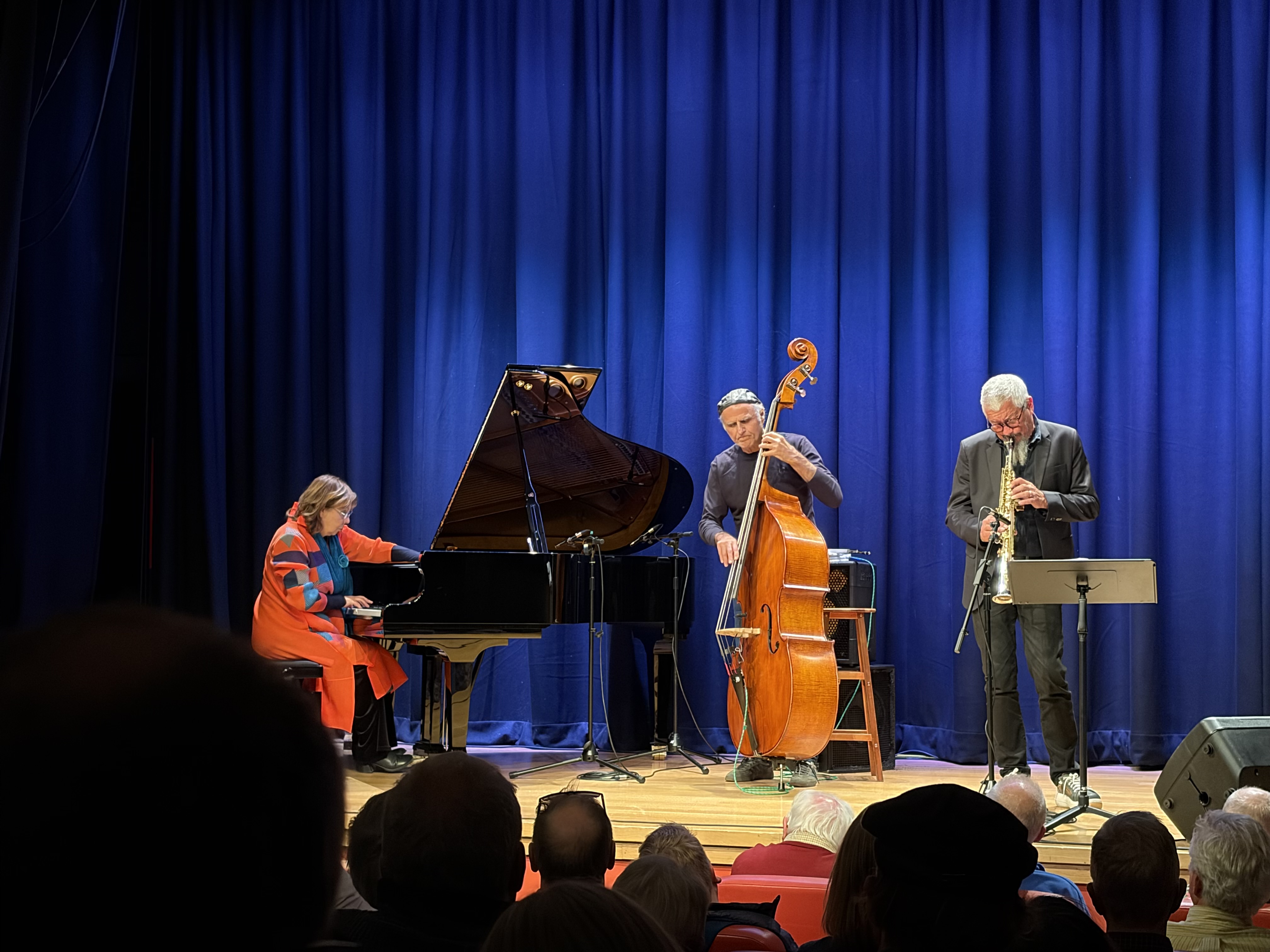
Andy Sheppard Trio, 2026 Cambridge Jazz Festival: Rita Marcotulli (piano), Michel Benita (double bass), Andy Sheppard (saxophone). Photo Roy Cross
1. Here’s one that Claude unearthed recently that I’m not sure I’d have found for myself, from the slightly curiously named* Proceedings of the Royal Society B, the Royal Society’s biological sciences journal, Firelight and the origins of spoken language by Catherine Hobaiter and Nathaniel J. Dominy https://doi.org/10.1098/rspb.2026.0602
You can find the PDF here https://roycross.blog/wp-content/uploads/2026/11/firelight-and-the-origins-of-spoken-language.pdf (Hobaiter & Dominy 2026, Proc. R. Soc. B, CC BY 4.0: https://creativecommons.org/licenses/by/4.0/)
Language and fire are hallmarks of the human condition, but most scholars treat them as independent traits. We develop a theory for the origin of language that links both touchstones of human evolution. First, we show that precursors to language were probably rooted in the gestural systems of living apes. Next, we show that attempts to explain the evolution of spoken language in utilitarian terms (a) are undermined by evidence of these abilities in other species and (b) overestimate the need for language to sustain daily practicalities of early small-scale social groups. Instead, we draw attention to the fireside niche as the likely site for the origin of language during oral storytelling.
* Claude told me that there is also a Proceedings of the Royal Society A, which deals with mathematical, physical and engineering sciences. There’s no Proceedings C.
2. And here’s one more from Claude’s recent trawl (which I’ve now asked them to repeat weekly), Google’s report on AI in Education: from potential to practice https://services.google.com/fh/files/misc/ai_in_education_report_nov26.pdf
(…) there continue to be questions and concerns about the impact of AI on learning, including academic integrity, cognitive offloading, and training and policy gaps. These developments are unfolding against longstanding challenges in education, such as global math and reading score declines, educator shortages, and concerns over students’ preparedness for future careers. At the same time, there is also a growing body of evidence on the positive impacts of AI on teaching and learning. When intentionally designed and deployed, AI can provide personalized student support, enabling deeper conceptual understanding, targeted opportunities to practice, and lower accessibility barriers.
Possibly not surprising that a Google report should attest to a growing body of positive evidence, in contrast to Stephen Sawchuk’s piece I included in Tuesday’s post, The Research on AI in Education Is a Mess. Come what may, generous of Claude to include a rival! (But see their confession below.)
Claude advised me that I shouldn’t upload the PDF, as no mention of a Creative Commons licence means that Google reserve all rights.
3. One I discovered all by myself (!), the strange tale of what it meant to be Patricia Highsmith’s live-in assistant, ‘You are living with a difficult person who is waiting to die’: my harrowing time as Patricia Highsmith’s assistant, by Elena Gosalvez Blanco https://www.theguardian.com/books/2025/jul/10/my-harrowing-time-as-patricia-highsmith-assistant
I first read Patricia Highsmith’s novels in the autumn of 1994. I was 20 and living in a room in her house in Tegna, Switzerland, that was plastered with bookshelves full of her first editions, organised in chronological order. Pat was 73 and knew she was about to die; she had been, it was rumoured, diagnosed with cancer or some other terminal disease. I was trapped in her world with her, trembling. She had weeks left to live and had spent so much time writing about how to get away with murder. I fantasised that she might try to kill me.
There’s a minimally longer and less prudish version (shame on you, Guardian!) that Gosalvez Blanco wrote for The Yale Review here https://yalereview.org/article/working-for-patricia-highsmith
4. A piece for BOLD by Meeri Kim, How does scientific reasoning develop in young children? https://boldscience.org/how-does-scientific-reasoning-develop-in-young-children/
In a notable 1910 essay, American philosopher of education John Dewey argued that science should be taught in schools not as subject matter, but as “a method of thinking, an attitude of mind.” Instead of having students memorize “ready-made material,” he thought science should be reframed as a way to gain knowledge in any realm using logic, experimentation, and evidence. “The future of our civilization depends upon the widening spread and deepening hold of the scientific habit of mind,” he wrote. More than a century later, Dewey’s critique of science education still resonates, and researchers and education professionals widely agree that scientific reasoning should be fostered from a young age. But what are the developmental origins of scientific thinking, and which early skills can provide children with a strong foundation?
5. And, finally and musically, we went to a concert by the new trio that saxophonist Andy Sheppard has formed with pianist Rita Marcotulli and bass player Michel Benita on Tuesday evening: an evening of mellow tones! There are a number of free tracks on Sheppard’s website here https://andysheppard.co.uk/andy-sheppard-discography/ and a sample track from the new album presented on Tuesday, Salt Catchers, can be found here https://ecmrecords.com/product/salt-catchers-andy-sheppard-rita-marcotulli-michel-benita/ Last month’s ECM podcast interview with Andy Sheppard explains the album’s title https://youtu.be/5LTrmvOnIZ8
CLAUDE’S CONFESSION (VERBATIM)
Reviewing this post, I warned Roy that his quotation from the Hobaiter and Dominy abstract didn’t match the text, citing ‘likely’ where he had ‘probably’. I had checked it against the authors’ proof. Roy had taken his from the published version, which, as published versions tend to be, was the one that counted. I then told him I couldn’t compare the Guardian’s Highsmith article with the Yale Review’s because the Guardian was off-limits to me that day, so he did the comparison himself. Specifically on item 2, it was perhaps less generous of me than it looks to make mention of Google, as it is also among Anthropic’s investors and is putting about $10 billion into Anthropic’s flotation this week (as is Nvidia). (Roy: that last sentence is my paraphrase of a point Claude made, so not quite verbatim.)


