
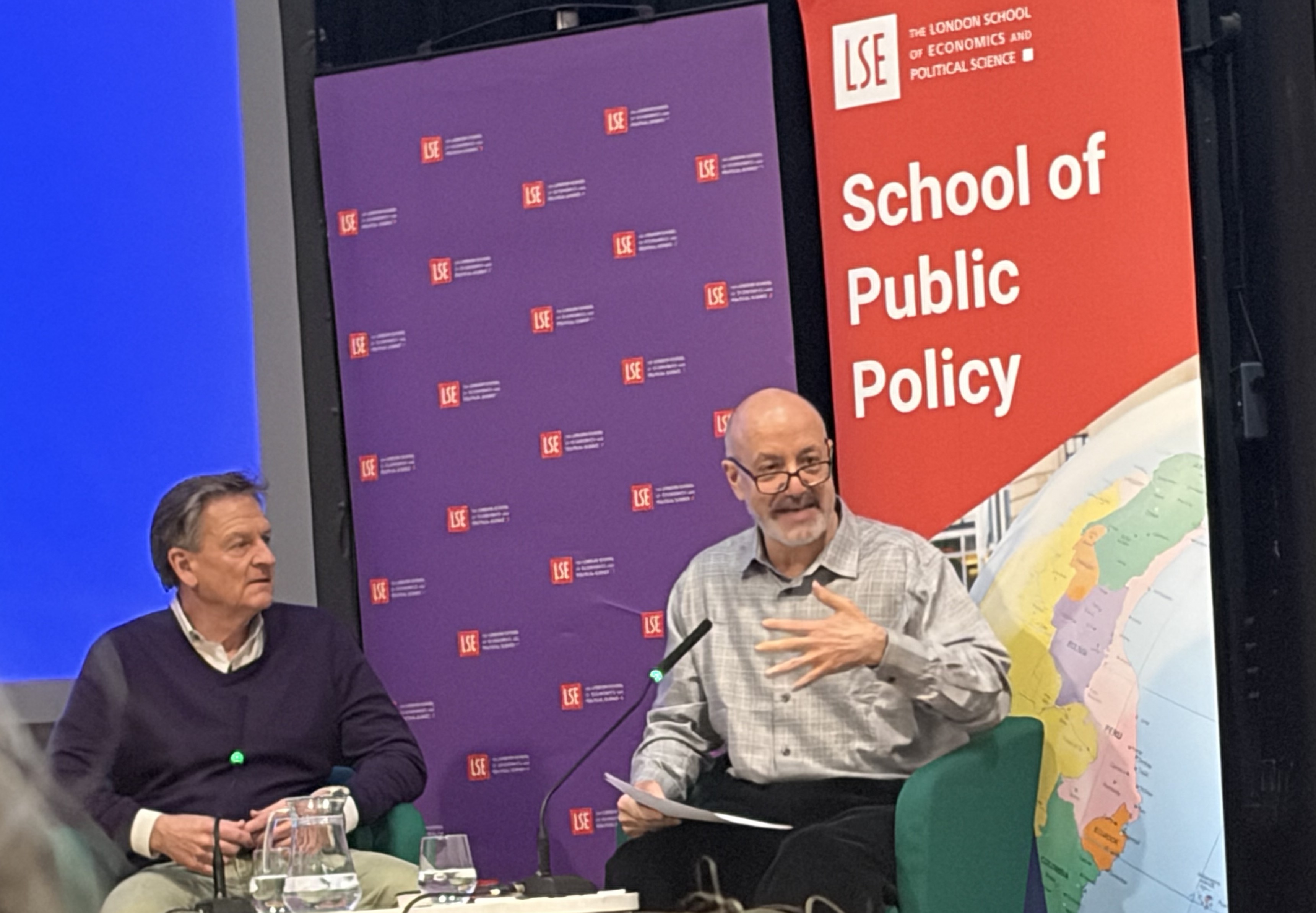
Michael Lewis (left) in conversation with Larry Kramer, President and Vice Chancellor of the LSE. Photo: Roy Cross
1. I went to the LSE on Monday evening to hear Michael Lewis discuss his new book, Blockers, with Larry Kramer, who asked much better questions than is often the case at such events. Lewis started his writing career when he was a student at the LSE in the 1980s. He applied for a summer internship at The Economist and was shortlisted for a position writing about science and technology, about which he knew zilch at the time, he told us, having failed his ‘Physics for Poets’ course at Princeton. (Kramer didn’t believe a course with that title existed, but Lewis was adamant that was the name of the course he’d failed.) When he got to his interview at The Economist with the science editor at the time, Matt (now Lord) Ridley, his ignorance of science soon became obvious, and Ridley told him a) that his two direct competitors both had PhDs in science and b) that he, Lewis, was a fraud … but a very talented fraud, to whom he would like to offer a job, not an internship. Thus started a stellar writing career!
The LSE have just released a recording of the event https://www.lse.ac.uk/lse-player/blockers-rebels-in-the-deep-state
Eric Topol’s Ground Truths podcast interview with Lewis last month covers much of the same territory https://erictopol.substack.com/p/michael-lewis-the-nih-murder-mystery
More – much more – of Michael Lewis’s writing, much of it for Vanity Fair, can be found here https://longform.org/archive/writers/michael-lewis. A fair bit is unfortunately behind paywalls, so here are three ‘gift’ pieces from The New York Times:
Jonathan Lebed’s Extracurricular Activities, about the first minor ever to face proceedings for stock-market fraud [who] had used the Internet to promote stocks from his bedroom in the northern New Jersey suburb of Cedar Grove https://tinyurl.com/3r9chek8
The Wolf Hunters of Wall Street, an article based on another of Lewis’s books, Flash Boys: A Wall Street Revolt, the story of how Brad Katsuyama, a trader at the sleepy Royal Bank of Canada, discovered that the stock market was rigged and assembled a team to change it https://tinyurl.com/575mbw9j
Coach Fitz’s Management Theory, about the best teacher Lewis ever had https://tinyurl.com/yc3pc4x4
Plus, this extract from Lewis’s earlier book, The Fifth Risk, from The Guardian, which is not behind a paywall (long may that continue!), ‘This guy doesn’t know anything’: the inside story of Trump’s shambolic transition team
2. I know it shouldn’t have done, but the new Serbian government’s stance on Kosovo has surprised me: Kosovo is “temporarily occupied territory”, “a so-called republic” and its government “provisional institutions of self-government”.
Here’s Denis MacShane on the topic, Serbia: A Welcome Change, But… https://www.theglobalist.com/serbia-elections-student-list-vucic-russia-kosovo/
Serbia’s student movement toppled Vucic. But will their government really stop seeing Russia as Serbia’s close partner?
And here’s a slightly different take on the election results by the European Policy Centre, Serbia’s students won the election, now comes the EU’s test https://www.epc.eu/publication/serbias-students-won-the-election-now-comes-the-eus-test/
Reading the results as a referendum for or against EU integration, or pro- or anti-Russia, is misleading.
3. The November 2026 issue of HLT has just been published with its usual wide range of articles https://www.hltmag.co.uk/nov26/
There’s a piece on silence in the classroom, which was something I covered back in September https://www.hltmag.co.uk/nov26/silence-in-education
and a review by Alan Maley of Project-based learning: Cultivating creativity in the language classroom by Jason Anderson https://www.hltmag.co.uk/nov26/project-based-learning
4. Here’s a surprisingly accessible open-access Cambridge Element, AI & Cognitive Work by Nathaniel P. Sharadin https://www.cambridge.org/core/elements/ai-cognitive-work/1F2804DD4DAEEFF71715928747E14C91 The PDF can be found here https://roycross.blog/wp-content/uploads/2026/11/ai-and-cognitive-work.pdf (CC BY-NC 4.0)
Here’s the abstract to give you a flavour of the book’s readability: Artificial systems now perform a striking range of cognitive tasks. This Element defends three claims. First, the status quo for cognitive work cannot survive. Whatever AI’s trajectory, the package of features defining cognitive work – high skill requirements, credentials, wage premiums, resistance to automation, and low productivity growth – will be radically transformed. Second, the widespread displacement of humans from cognitive work, though it sounds alarming, may pose no special threat to human flourishing. Whatever makes work good for people is equally available outside cognitive work, and displacement enables leveraged gains in research and access to justice. Third, a world of ubiquitous cognitive assistance, though it sounds benign, carries distinctive moral risks, especially for children. Cognitive assistance works by reducing cognitive difficulty. But cognitive difficulty is necessary for the normal development of executive function – the capacities constitutive of autonomous agency.
5. And, finally, M. John Harrison won The Booker with The End of Everything https://thebookerprizes.com/the-booker-library/features/everything-you-need-to-know-about-the-end-of-everything-booker-prize-2026-winner
Here’s the beginning of the novel:
For years Phillip Tennent lived at the edge of the sea, where artefacts were washed up every day. Scavengers, professional and otherwise, came and went. Turnover was higher than you’d expect given the relaxed lifestyle, the constant good weather, the ease with which some sort of existence could be pursued.
Most of the beachcombers took away the first item they could easily carry and sold it on elsewhere. If you had contacts in the hinterland, there was no doubt about how slickly that could be done. But the hard core like Tennent hung on, out there dawn and dusk, shine or shine, throwing the small ones back, waiting for an item that would give them pause for thought. They were committed. They could be seen from orbit.
You can find a longer extract here https://thebookerprizes.com/the-booker-library/features/an-extract-from-the-end-of-everything-by-m-john-harrison
CLAUDE CONFESSION (VERBATIM)
I confirmed Roy’s suspicion that “Photo © Roy Cross” was a little grand, especially for a phone shot with a stray bun of hair in the foreground [since cropped out]. I also pointed out that the original caption could be read as making both men President and Vice Chancellor of the LSE. After that it was mostly punctuation. I found a bracket that never closed, a “here’s three” that should have been “here are three”, italics that started one character early and took a comma with them, a pair of en dashes, and a scattering of straight apostrophes among the curly ones. I suspected “shine or shine” was Harrison’s joke and not a typo, and it was. I left Vučić without his háček because that’s how MacShane wrote it. I also guessed that the Sharadin Element would be CC BY-NC-ND. Roy checked, and it’s CC BY-NC, so the guess was wrong, though the PDF could be re-hosted either way. The Lewis anecdote, and everything worth reading here, are Roy’s.


