
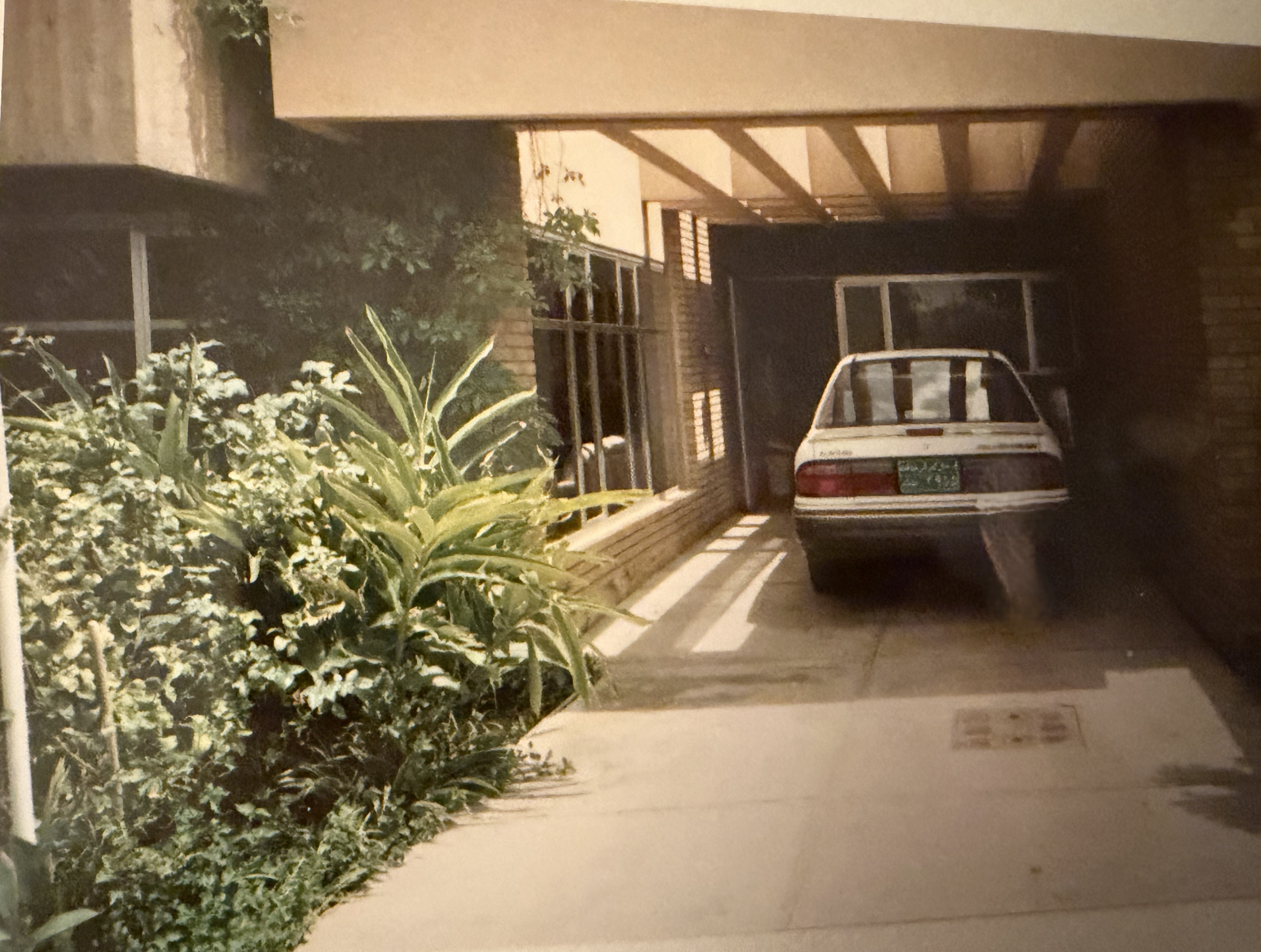
Not a great photo but one which brings back memories which were prompted by the Simon Borg piece on Iraq below: our house and car in Baghdad, where we spent a hugely rewarding year from September 1989, our posting curtailed by Saddam’s invasion of Kuwait in August 1990, when we were on holiday in Italy. Our car in the photo is parked where the Deputy Minister of Education used to park his car, boot to the back door, so I could discreetly put a case of Radeberger Pilsner beer in the boot for him.
1. Four self-proclaimed, substantial ‘provocations’ exploring four shifts reshaping the UK written as background to this year’s Policy Live event from Nesta, one of those organisations whose acronym has wobbled over time, which now describes itself as not just any but ‘the research and innovation foundation’.
a) What does ‘good devolution’ look like?
As Leeds-based blogger Tom Forth often reminds his readers, Leeds is the largest city in Europe that does not have a tram. That is bad news for Leeds. The Centre for Cities’s report on public transport notes that only 38% of Leeds’ population can get to the centre within 30 minutes. If it had a tram, that number would rise to 61% – close to the European average of 67%.
b) Why Britain feels worse than it is
When we looked at recent data, we found that the ‘average’ person in the UK is now pessimistic about what’s ahead for the UK. And this sense of deep pessimism in the UK’s future is ticking up: around 70% of us are now pessimistic about the future of the country, up from around 50% in 2018. Most of us do not think that our children will be better off than we currently are. We think that the UK has somehow lost its way, and we don’t have much faith that it will correct its course – not now, nor in future years.
c) Sustaining British power in a coercive world
The international order that shaped British foreign policy after the Cold War is fracturing along three by now familiar lines. The first is the return of great power competition between the United States (US) and China, alongside the rise of a range of significant new global middle powers. The second is the related decline of the old liberal international order, built and underwritten by the US since 1945. With this decline comes the weakening of many of the old multilateral institutions this system created, as major powers pursue narrower and more transactional interests. The third is the weaponisation of economic and political interdependence in what remains a still remarkably global world, meaning that interconnecting systems of trade, finance, technology and data can be used as instruments of state coercion.
d) How the UK can crest the AI wave
At Nazaré [in Portugal], a great undersea canyon channels the energy of the Atlantic into walls of water 100 feet high. Surfers launch themselves onto these walls and try to hold control at the edge of uncontrol, reading every variation in the great power behind them. Looking at the AI wave – and the broader technological sequence it belongs to – we are all like those surfers at Nazaré. The question is whether we can understand this power well enough to ride the wave towards human self-realisation, or will we spend the coming decades mobilising all our efforts of rescue?
You can find the whole Policy Live programme here https://www.policylive.org/nesta/399/agenda and recordings of a number of the sessions here https://youtube.com/playlist?list=PLODB3YBglaNc
2. Still open access, to my slight surprise, the latest Times HE World University Rankings, which show how the global centre of HE gravity is continuing to move away from Europe and the USA https://www.timeshighereducation.com/world-university-rankings/latest/world-ranking
3. A good, clear exposition of Classroom action research – the what, the why and the how – from the TeachingEnglish team https://www.teachingenglish.org.uk/professional-development/teacher-educators/teaching-teachers/classroom-action-research
Classroom action research begins with a question or questions about classroom experiences, issues, or challenges. It is a reflective process which helps teachers to explore and examine aspects of teaching and learning and to take action to change and improve.
4. A series of three blog posts from Simon Borg on Reforming English Pre-Service Teacher Education describing work he’s done recently in Iraq that he hopes “will be relevant to educational reform contexts elsewhere”:
Educational reform is best understood as a process rather than an event, requiring sustained interaction between policy, implementation and professional learning. Since 2021, I have contributed to a collaborative reform project involving the British Council and the Ministries of Higher Education and Scientific Research in Federal Iraq and the Kurdistan Region that aims to strengthen pre-service English teacher education nationally. The timeline below summarises the main stages of this five-year programme of work. In a three-part blog, I will describe the work completed (Parts 1 and 2) and (in Part 3) reflect on lessons learned for the reform of pre-service English teacher education programmes.
5. And, finally, from the admirable Public Domain Review, the story of Lieutenant Colonel James Skinner (1778-1841), “the son of a Scottish East India Company officer and (he claimed) a kidnapped Bhojpuri noblewoman, he was initially excluded from EIC service on account of his race but was brought back into the fold following the successes of his irregular cavalry, Skinner’s Horse, in the service of the Mughal Empire” https://publicdomainreview.org/collection/james-skinner-india-castes/
CLAUDE CONFESSION
Claude checked all the links, pointed out that my original photo caption might be read as me smuggling beer into my own car, fixed a stray en dash, was helpfully strict with my quotation practice, taught me something I didn’t know about the use of square brackets, and asked me to prove that Nesta did indeed call their essays provocations.


