Tuesday, 20th December (Richmond)

1. A provocative piece by Michael Feldstein on his blog, I Would Have Cheated in College Using ChatGPT https://eliterate.us/i-would-have-cheated-in-college-using-chatgpt/

‘But I wouldn’t have thought of it as cheating’, says Michael. ‘Cheating is a state of mind.’

2. So, I thought I’d give ChatGPT a go.

With an eye (ear?) to developments in Artificial Intelligence, I asked the ChatGPT bot, “For how much longer will we need to learn foreign languages?” The bot replied immediately:

“Learning a foreign language can be a valuable and enriching experience for many people, and it is likely that the need for multilingualism will continue for the foreseeable future. There are a number of reasons why learning a foreign language may be important or beneficial: Communication: Being able to speak a foreign language can make it easier to communicate with people who speak that language, whether you are traveling, working, or interacting with others in your community. Career advancement: Many employers place a high value on employees who are proficient in a foreign language, as it can be an asset in a globalized economy. Cultural understanding: Learning a foreign language can also help you learn about and understand different cultures, which can broaden your perspective and enrich your life. Brain health: Studies have shown that learning a foreign language can have cognitive benefits, such as improving memory and problem-solving skills. Overall, the need for multilingualism is likely to continue as long as there are diverse languages spoken around the world and people who want to communicate and interact with one another.”

I made myself clearer in a supplementary question: “But won’t advances in AI mean that we will all benefit from instant, high-quality translation and interpreting?”, to which the bot replied, again pretty much straightaway:

“While advances in artificial intelligence and machine translation have made it possible to translate texts and spoken language with increasing accuracy, there are limitations to what these technologies can currently do. Machine translation systems are generally best at translating individual words and short phrases, but they can struggle with idiomatic expressions, complex sentences, and context-dependent meanings. As a result, they may produce translations that are less accurate or natural-sounding than those produced by a human translator.

In addition, machine translation systems do not currently have the ability to interpret spoken language in real time, which requires a level of understanding and interpretation that goes beyond simply translating words. Interpreting involves not only conveying the meaning of the words being spoken, but also capturing the tone, style, and intent of the speaker, as well as adapting to the context of the conversation. This is a complex task that requires a high level of language proficiency and cultural knowledge, which can be difficult for a machine to replicate.

As a result, it is likely that the need for human translators and interpreters will continue for the foreseeable future, especially for situations where accuracy and nuance are important. That being said, it is possible that machine translation and interpreting technologies will continue to improve over time, and they may eventually be able to handle more complex tasks.”

One last question from me: “Can I talk to you in other languages apart from English?”

“Yes, you can talk to me in any language that you know. As an artificial intelligence, I am not limited to understanding or communicating in a particular language. However, please keep in mind that my ability to understand and respond to a language may depend on my training data and the specific language model I was built from. If you would like to communicate with me in a language other than English, I will do my best to understand and respond appropriately based on my programming. If I am unable to understand what you are saying or if I make a mistake, please let me know and I will do my best to improve my understanding.”

Try it for yourself! https://openai.com/blog/chatgpt/

3. Dictionary definition sparks global culture clash is a necessarily carefully-written piece by Melanie Butler from the latest issue of EL Gazette https://www.elgazette.com/dictionary-definition-sparks-global-culture-clash/ Be sure to read to the end for the West African Pidgin versions!

4. And, finally, if you’ve not yet had quite enough of football – my wife certainly has! – here’s three football pieces:

Chris Sowton’s new podcast for TeachingEnglish, https://www.teachingenglish.org.uk/professional-development/podcast/teaching-english

the Premier Skills English website, stuffed with material and activities https://premierskillsenglish.britishcouncil.org/

and The Athletic’s poignant story of the young French player, Yann Gueho, who everyone was sure would be a better player than Kylian Mbappé https://theathletic.com/3975061/2022/12/09/yann-gueho-france-chelsea-mbappe/

Maybe don’t bother reading that last piece if you haven’t heard of Kylian Mbappé! If that last link doesn’t work, let me know and I’ll see what I can do.

Posted in Uncategorized | Leave a comment

Thursday, 15th December (back in Cambridge)

1. The December issue of HLT (Humanising Language Teaching) https://www.hltmag.co.uk/dec22/ includes a ‘video article’ by John Hughes, Cuisenaire Rods Today https://www.hltmag.co.uk/dec22/cuisenaire-rods-today which sent me off on a trip down Memory Lane to the time when, as a trainee teacher, I had an argument with Mario Rinvolucri during his demonstration of the Silent Way to my course, using Cuisenaire Rods.

As my memory has it – and I’m increasingly unsure about anything my memory may think it ‘has’ – Mario was teaching us Modern Greek, which involved us asking in Modern Greek for, for example, ‘two red rods’ or ‘three green rods’. I wanted to know how to say ‘thank you’ in Modern Greek when I’d been given the rods I asked for. For reasons I still don’t understand more than forty years later, Mario was most put out and refused to tell me, despite my digging my heels in with the support of my fellow trainees. I grew to love Mario, though!

Here’s a good short summary of the Silent Way https://www.cambridge.org/core/books/abs/approaches-and-methods-in-language-teaching/silent-way/75639151C49CFB9FECC02814BDE9200B

here’s the Wikipedia entry on the approach, which was developed by Caleb Cattegno in the 1960s https://en.wikipedia.org/wiki/Silent_Way

and here’s a selection of articles from the TeachingEnglish site on the Silent Way https://www.teachingenglish.org.uk/article/silent-way

2. I’m just back this evening from the European Centre of Modern Languages (ECML) in Graz, which is a ‘partial agreement’ of the Council of Europe (CoE) – a ‘partial’ agreement because not all member states of the CoE are members of the ECML. (The non-members include the UK, sadly, but I’ll save my rant about the disgraceful manner in which we left for another day.) The CoE now has a much smaller languages department than it used to have in the days of John Trim and Joe Sheils, but it still produces some good stuff. Here’s two recent videos on plurilingualism: Plurilingualism/Pluriculturalism and (Language) Education with Enrica Piccardo https://vimeo.com/user82789672 and Engaging learners’ plurilingual and pluricultural competence with Angelica Galante https://vimeo.com/user82789672

3. Two videos about politics, democracy and a free press here in the UK:

i) the 2022 Leveson Lecture by Chris Bryant, The Truth Algorithm https://youtu.be/GTfRwxeEa8o With a bonus introduction by Hugh Grant ….

ii) the Hansard Society’s journal ‘Parliamentary Affairs’ 75th Anniversary Lecture by The Lord Speaker, the Rt Hon the Lord McFall of Alcluith, on The Future of the House of Lords https://youtu.be/wKS2R8GGaGc  You might be surprised how informal, despite his grand title, and candid John McFall is.

4. And, finally and gleefully, the best piece of research ever, which endorses the habit of a lifetime https://theconversation.com/procrastination-the-cognitive-biases-that-enable-it-and-why-its-sometimes-useful-195845

Posted in Uncategorized | Leave a comment

Tuesday, 13th December (Graz)

1. I’m in Graz at present, about to attend the ECML-EU joint colloquium on “Innovative Methodologies and Assessment in Language Learning 10 years on – moving forward together”.

There’s a live stream this afternoon https://youtu.be/nxMgt7PmLmA and tomorrow afternoon https://youtu.be/lT9ZiwiP1Nw

More details of the programme with links to the individual projects being reported on here https://www.ecml.at/ECML-Programme/Programme2020-2023/ECML-ECColloquiumDecember2022/tabid/5607/Default.aspx

2. Two interesting webinars later this week, of which the first is at 14:00 UK time this Thursday, 15th December, Integrating new learners with Elaine Gowie-Fleischer https://www.facebook.com/events/815447603087187?acontext=%7B%22event_action_history%22%3A[%7B%22surface%22%3A%22page%22%7D]%7D

Elaine will discuss with Karen Waterston how to integrate new students that have come from a different culture, when language is often a barrier to integration as well as culture, taking examples from her work with children and their families when they first start state school in Norway.

3. The second webinar is at 14:00 UK time on Friday, 16th December, Green story time: the power of picturebooks for all ages with storytelling experts Gail Ellis and Sandie Mourão, the co-founders of co-founders of the Picturebooks in European Primary English Language Teaching project (PEPELT) https://pepelt21.com/ They’ll share some of their favourite environmental-themed picture-books for English language learners of all ages.

More info here https://green-action-elt.uk/events/ and registration here https://nile-elt.zoom.us/meeting/register/tZErdeuhqTkiHNx8wEuQ5s6L-pJ6Js3sA_q2

There’s a picture-book for everyone, claim Gail and Sandie, because “picturebooks not only contain rich, varied language and beautiful illustrations, but they’re an excellent way to grapple with difficult topics like the ecological and climate crises”.

4. And, finally, three more ‘gift’ article-cum-lists from my New York Times subscription:

the greatest films of all time https://tinyurl.com/yc3r734z (Full list here https://www.bfi.org.uk/sight-and-sound/greatest-films-all-time )

the best Jazz Albums of 2022, with taster playlist https://tinyurl.com/sr948amx – not one of which I knew but several of which I enjoyed, especially Immanuel Wilkins. (You can listen to the whole tracks on Spotify for free if you have an account.)

100 Notable Books of 2022 https://tinyurl.com/bdzb5dre – with the obvious caveat that what’s notable to the staff of the New York Times may not be universally, globally ‘notable’

Posted in Uncategorized | Leave a comment

Thursday, 8th December (Richmond)

1. We’ve had a plethora of ‘words of the year’ recently. I mentioned the controversial (from a UK perspective) Cambridge word of the year – ‘homer’ – on 22nd November, and now we have the Oxford one https://languages.oup.com/word-of-the-year/2022/ and the Collins one https://blog.collinsdictionary.com/language-lovers/a-year-of-permacrisis/ both also controversial, in different ways: the Oxford one because it’s two words, not one – ‘goblin mode’ – and the Collins one – ‘permacrisis’ – because Greek scholars think it’s a contradiction in terms, in terms of its Greek origins, at least – a ‘crisis’ is temporary and cannot by definition be ‘perma’, permanent.

The Oxford word was, for the first time,  the ‘people’s choice’ this year – more than 300,000 voted – and it’s completely and utterly new to me. I should clearly get out onto social media more. Here’s the BBC’s commentary, including Susie Dent’s defence of  a two-word ‘word of the year’ https://www.bbc.com/news/uk-63857329 and an article in The Times which I hope hasn’t retreated behind their paywall https://www.thetimes.co.uk/article/3cc27258-74cd-11ed-8dd6-146590878cf8

And here’s one individual’s choice of their word of the year, on freelance lexicographer Julie Moore’s Lexicoblog https://lexicoblog.blogspot.com/2022/11/my-word-of-year-year-late.html

2. If you want to avoid being replaced by a computer, then you’d better listen to the session by Mark Richard and Edmund Dudley that opens ELTOC at 11:00 UK time tomorrow, Friday 9th December, How to Avoid Being Replaced by a Computer. More information on the two-day programme and details of where to watch here https://elt.oup.com/feature/global/eltoc/?cc=gb&selLanguage=en Colourful PDF of programme below.

3. When I started teaching – which wasn’t yesterday, I admit – the use of any other language than English in an English as a Foreign Language (EFL) classroom was a serious pedagogical ‘crime’. We’ve come a long way since then. On 12th December at 12:00 UK time, Nelson Arditto will be presenting Rethinking multilingualism and the use of the L1 in English as a medium of instruction. More info here https://www.teachingenglish.org.uk/article/rethinking-multilingualism-and-use-l1-english-medium-instruction

Here’s the blurb for Nelson’s talk: “In recent years, the ‘multilingual turn’ has risen to challenge preconceived ideas that L2 learning can only happen through the exclusive use of English. This webinar will provide a background to the predominance of second language acquisition theories in EMI classrooms and question monolingual practices based on a hierarchical perspective of languages. It will look at the concept of ‘translanguaging’ as the hallmark of bilingual speakers and explore pedagogical and spontaneous uses in the EMI/CLIL classroom. Participants will consider their beliefs and attitudes with regard to using the L1 in teaching and learning content and language and go away with some ideas and activities to try out in their teaching contexts.”

4. And, finally and more politically, here’s the Scottish Review’s word of the week, which taught me the origin of the expression ‘to strike’ https://www.scottishreview.net//AnthonySeaton640a.html

Posted in Uncategorized | Leave a comment

Tuesday, 6th December (Richmond)

1. Timothy Snyder from Yale University is putting his lecture course on The Making of Modern Ukraine online as he goes. Here’s Lecture 1, which is an introduction to the themes of the course, which also explores more general notions of nationhood using Ukraine as an example https://youtu.be/bJczLlwp-d8

Lecture 22 (of a planned 23 or 24, I think), Ukrainian Ideas in the 21st Century, was last Thursday https://youtu.be/yz6MSiGZQCU

As you can see from the comments, not everyone agrees with him.

2. The NATESOL December webinar is this Saturday, 10th December at 10:00 UK time: Clare Courtney’s title is the rather neat Heart & Parcel: using creative learner-focused approaches to welcome new arrivals More info and registration  here https://docs.google.com/forms/d/e/1FAIpQLSdxFGXMM7YQmSL5phxVg-gyxx40miU3aP3t2qSFNb9-NrQmZw/viewform

3. I’d certainly have found BISH useful at the age of fourteen (and later!) https://www.bishuk.com/

4. Here’s our occasional three from The Conversation:

Working less is a good thing: https://theconversation.com/four-day-week-trial-confirms-working-less-increases-wellbeing-and-productivity-195660

And so is walking backwards: https://theconversation.com/walking-backwards-has-a-surprising-number-of-health-benefits-195246

But is ayahuasca? https://theconversation.com/ayahuasca-just-how-safe-is-this-psychoactive-brew-194475

5. And, finally and psychedelically, Carlos Castaneda was a popular read when I was at university in the mid-1970s. Having read that piece from The Conversation on ayahuasca, I Googled him the other day, and I’ve now learnt that he made it all up, never met a Yaqui shaman, and very likely never took ayahuasca at all! 

Here’s an account for Open, the Indian weekly current affairs and features magazine, by Santhosh Babu of his experience of taking ayahuasca (and kampo and bufo) https://openthemagazine.com/columns/guest-column/the-ayahuasca-story/

Posted in Uncategorized | Leave a comment

Thursday, 1st December (Cambridge)

1. This one’s a bit specific, for those of you that completed – or supervised the completion of – an MA thesis at a European university during 2022 within the area of language use, language policy and multilingualism.

EFNIL http://efnil.org/ is the European Federation of National Institutes for Language. Each year they run a competition to find the best master’s theses in Europe, and the winners get a €1,500 prize and a free trip to the EFNIL conference. The languages studied in the thesis may be any of the European national languages. Please note, say EFNIL, that English is still one of the official languages!

More detailed information here http://efnil.org/master-thesis-award/master-thesis-award

NB! The deadline is 15th January.

2. Two pieces with a focus on South Asia:

first, the recording of a lecture for the Asia Scotland Institute by John Keay, Himalaya: Crisis on the Roof of the World? https://youtu.be/aIdAUiay6Tc;

second, a short film from The Guardian, The Great Abandonment, about migrant workers within India https://www.theguardian.com/world/ng-interactive/2022/nov/23/the-great-abandonment-the-extraordinary-exodus-of-indias-migrant-labourers

3. Sound advice from the gov.uk site on Designing for people with dyscalculia and low numeracy https://designnotes.blog.gov.uk/2022/11/28/designing-for-people-with-dyscalculia-and-low-numeracy/

More on dyscalculia, which is a challenge for more people than perhaps we realise, here https://www.dyscalculianetwork.com/ including a short video introduction https://youtu.be/HVf_OHK2hHQ

4. Michael Rosen made a splendid host for last night’s ELTons awards ceremony. He performed one of his poems, Hot Food https://youtu.be/Akwm2UZJ34o

Lots more on his YouTube channel here https://www.youtube.com/@MichaelRosenOfficial

5. And, finally and uncomfortably, from the Radio 5 ‘Teach me a Lesson’ series, Where’s The Most Painful Place To Get A Tattoo? https://www.bbc.co.uk/programmes/p0cdhpjm

More episodes here https://www.bbc.co.uk/programmes/p095y1m1/episodes/player

Posted in Uncategorized | Leave a comment

Tuesday, 29th November (Cambridge)

1. The UN International Day of Persons with Disabilities (IDPD) is held on 3rd December each year. This Friday, December 2nd, the TeachingEnglish team are holding an online event in support of IDPD on Special Educational Needs and Disabilities in English Language Teaching, comprising four webinars and a panel discussion. More info about topics and speakers and registration here https://www.teachingenglish.org.uk/article/online-event-special-educational-needs-and-disabilities-english-language-teaching

More info on the IDPD, including two short videos, here https://www.un.org/en/observances/day-of-persons-with-disabilities

2. The IATEFL Global Issues SIG (Special Interest Group) is convening a panel discussion on Teacher Activism in Times of Adversity with Akemi Iwasa, Margarita Kosior and Laszlo Hajba at 15:00 UK time on Saturday, 3rd December. Registration here https://docs.google.com/forms/d/e/1FAIpQLSc_ewEPr7ZTiuTm3UAHDFHNqVKPCu2lH_7ggVNYa8z-MRFeNQ/viewform?fbclid=IwAR0sftq9odtY6sen0qQfecRFthq9C0LpwZ3xtXZI0K2ER4vcTpOgLkVZo_o

3. Dave Reay from Edinburgh University offers his analysis of the Successes and failures of COP27 here https://www.climatexchange.org.uk/blog/successes-and-failures-of-cop27/ If you’d rather listen – or want to set a homework task? – there’s a video version at the bottom of the page.

The bald one-sentence summary of Dave’s piece is that “a fund for loss and damage is good news from COP27, but the goal of limiting warming to 1.5C is lost and that of 2C is badly damaged”.

4. I’ve just discovered and much enjoy the Something Rhymes with Purple podcast about words and their origin by Susie Dent and Gyles Brandreth – Brandreth is a bit Marmite, but Dent manages him well! https://podcasts.apple.com/gb/podcast/something-rhymes-with-purple/id1456772823 or https://open.spotify.com/show/7ntItPoYGVgBKzFOYnQgbR

Here’s the Macmillan Dictionary explanation of what we mean when we say a person’s ‘a bit Marmite’ https://www.macmillandictionary.com/buzzword/entries/marmite.html

5. A quick reminder that it’s the ELTons tomorrow! https://www.teachingenglish.org.uk/article/eltons-innovation-awards-2022-live-stream

6. And, finally and whimsically, I’ve just discovered that it’s simply a fib that there’s one single shortest day each year. There are no fewer than seven days here in Cambridge of equal (short) length this year, the whole of the week beginning Sunday 18th December, when the days will all be seven hours and forty-four minutes long http://www.happyzebra.com/timezones-worldclock/sunrisesunset.php?city=Cambridge And the Cambridge shortest day is a whopping twenty-four minutes longer than the Richmond shortest day, of which there are five, beginning Tuesday 20th December.

Posted in Uncategorized | Leave a comment

Thursday, 24th November (Richmond)

1. The 2nd ‘Decentring ELT’ conference will be held on 10th and 11th March next year, and the call for papers is now open. More info on both the conference itself and the ‘decentring’ concept here https://www.hornby-trust.org.uk/decentring-elt and in the first PDF below. You’ll find a brief report on the 1st ‘Decentring ELT’ conference, including links to video recordings of the conference sessions, on the same page or in the second PDF below.

As the Hornby Trust website puts it, “The world of ELT has been characterised by a hegemony of ‘global’ or ‘centre’ ELT approaches and materials developed outside the teaching contexts in which they are expected to be used. However, these approaches and materials (‘frames for action’) are not necessarily appropriate to and do not recognise teachers’ and other insiders’ experience and expertise in those contexts.”

2. It’s that time of year again! Next Wednesday, 30th December, sees the (increasingly less hegemonic) annual ELTons awards ceremony for innovation in ELT, hosted this year by Michael Rosen. You’ll find all the finalists, who will all have their fingers and toes firmly crossed till Wednesday evening, listed here https://www.teachingenglish.org.uk/article/eltons-innovation-awards-2022-finalists and you can watch the ceremony from 17:00 UK time next Wednesday on the TeachingEnglish Facebook page here https://www.facebook.com/TeachingEnglish.BritishCouncil

3. At 14:00 UK time this Saturday, 26th November, Anna Hasper and Jonathan Hadley, the authors of ‘Supplementary Activities for English Language Teaching: Large Classes and Low Resource Contexts’ are presenting the second event in TransformELT’s series on ‘Teaching English to large classes’. More info and registration herehttps://www.eventbrite.co.uk/e/teaching-english-to-large-classes-part-2-tickets-470938508757 You can download a PDF of Anna and Jonathan’s book here https://www.britishcouncil.com.sn/en/programmes/education/english-connects/teachers-resources/supplementary-activities and it’s also attached below, just in case.

4. There have been times recently when it has seemed that the UK is falling apart at the seams. Opinions differ as to why that might be. ICAI, the Independent Commission for Aid Impact, however, continues to exemplify the UK’s ability to look at itself critically. Their latest report, UK aid to Afghanistan, “examines the relevance, coherence and effectiveness of the UK’s aid investment in Afghanistan since 2014” https://icai.independent.gov.uk/review/uk-aid-to-afghanistan/review/ ‘Not great’ is their verdict, alas. PDFs of report and literature review below.

5. And, finally and poetically and wholly less depressingly, a conversation between Edward Mendelson, the world’s foremost Auden scholar, and Sam Leith of The Spectator https://www.spectator.co.uk/podcast/edward-mendelson-complete-poems-of-w-h-auden/ And here’s the poem that Edward says makes him cry every time he reads it, River Profile https://allpoetry.com/River-Profile Requires and repays a second and third reading!

Posted in Uncategorized | Leave a comment

Tuesday, 22nd November (Richmond)

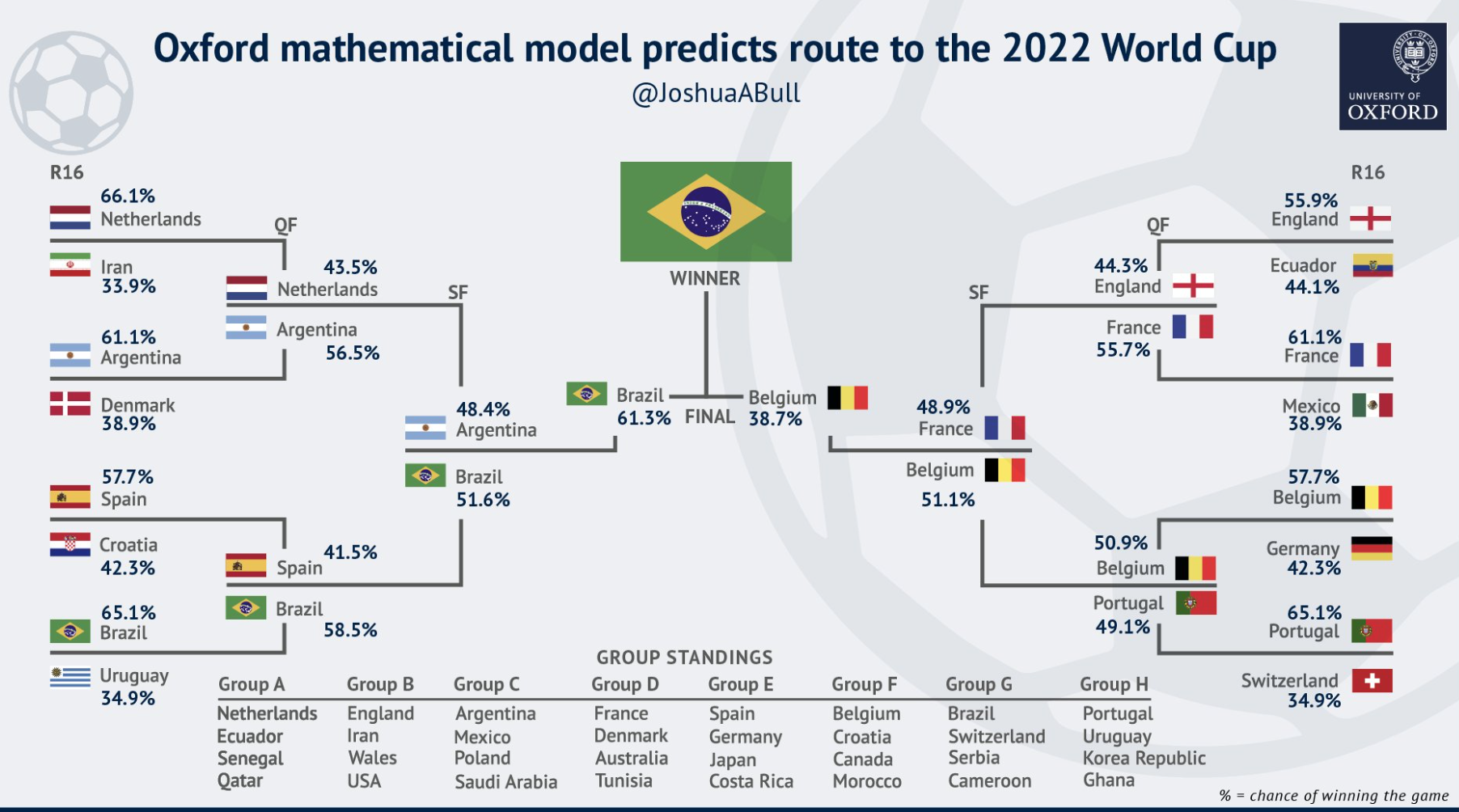
1. Joshua Bell is a post-doctoral researcher in the Maths Department at Oxford University; he also beat more than eight million (!) other players worldwide, including the world’s best chess player, Magnus Carlsen, when he won the Fantasy Football League in 2019/20. (Carlsen ended up tenth or eleventh, I think.) Two reasons why Bell might be quite a good person to predict the outcome of the World Cup currently taking place in Qatar, so here’s his A Mathematician’s Guide to the World Cup https://youtu.be/KjISuCarlsenZ5o06Q PDF of Dr Bell’s predictions below

and here’s another of his lectures, Can maths tell us how to win at Fantasy Football? https://youtu.be/LzEuweGrHvc

2. This World Cup is a controversial one in several ways. Here’s a piece from Spiegel International, Qatar Has Spent Years Preparing, But Is the World Ready? https://www.spiegel.de/international/world/the-winter-world-cup-qatar-has-spent-years-preparing-but-is-the-world-ready-a-21d5c58f-86f6-4bd4-b394-289649e0cebe

and here’s the lively inaugural podcast from The i newspaper, The truth about how Qatar treats LGBT people https://inews.co.uk/news/the-i-podcast-the-truth-about-how-qatar-treats-lgbt-people-1980698?ico=in-line_link

3. I mentioned Green ELT earlier this month. At 14:00 UK time this Friday, 25th November, Arran Stibbe, who’s Professor in Ecological Linguistics at The University of Gloucestershire, will be talking about ELT & ecology: how language shapes our world More info and registration here https://green-action-elt.uk/events/

4. Here’s a blog post from the Cambridge Dictionary explaining their surprising choice of ‘word of the year’ for 2022 https://dictionaryblog.cambridge.org/2022/11/16/cambridge-dictionarys-word-of-the-year-2022/

5. And, finally and doggedly, a highly effective visit to the market https://twitter.com/TansuYegen/status/1593239732649332744?t=9mdbacmejCtno37hJG_Isg&s=19

Posted in Uncategorized | Leave a comment

Thursday, 17th  November (Cambridge)

1. You’ll find reports on all forty Partnered Remote Language Improvement (PRELIM) 2 partnerships – from ‘A’ for Angola to ’Z’ for Zambia! – here, plus Martyn Clarke and Rose Aylett’s summary report. https://www.teachingenglish.org.uk/article/partnered-remote-language-improvement-prelim-2-project-report

PDF of Rose and Martyn’s report below; I’ll leave you to download the country reports you’re interested in for yourselves!

Just this morning, wearing my new NILE hat, I was helping review the UK applications for PRELIM 3. There’s still just time for English Teacher Associations to apply – application form below. The deadline is 23:59 UK time next Monday, 21st November!

2. One of the strengths of both PRELIM 1 and PRELIM 2 was the community of practice established between the UK language schools who took part. Some interesting thoughts here from Network Weaver on what makes communities of practice (otherwise known as ‘peer learning circles’) work, most of which I think Rose and Martyn would agree with https://networkweaver.com/peer-learning-changes-everything-but-how-to-make-it-work/

Network Weaver also offer a free Introduction to Networks facilitated by Collective Mind, described as ‘interactive training to learn about our comprehensive framework for understanding networks and ensuring their impact’. More details here; there’s a choice of dates https://networkweaver.com/events/

3. Olivia Douglass has just won this year’s 4thWrite prize with her short story, ‘Ink’ and you can read it here https://www.theguardian.com/books/2022/nov/16/the-4thwrite-short-story-prize-winner-a-young-mothers-chance-encounter-with-an-old-classmate

A bit more on the 4thWrite prize here https://www.theguardian.com/books/2022/nov/16/olivia-douglass-wins-4thwrite-prize-for-gripping-short-story-ink

4. Went to a great concert by Abdullah Ibrahim on Tuesday evening. Here’s his Tiny Desk (Home) Concert for NPR: https://youtu.be/L5i4stj4M30

5. And, finally and automotively, one of my ten monthly New York Times ‘gift’ articles, What Riding in a Self-Driving Tesla Tells Us About the Future of Autonomy https://nyti.ms/3hMLQ6Q There are a few bugs left, it seems!

Posted in Uncategorized | Leave a comment