
1. The first of two I’ve pilfered from LinkedIn, this one from World Englishes, courtesy of Richard Smith (thank you, Richard!), WE, ELF and ELT: Perspectives on English and applied linguistics by Henry Widdowson https://onlinelibrary.wiley.com/doi/epdf/10.1111/weng.70010 (PDF below as well.)
Here’s Henry’s abstract, so you can work out if it’s your kind of read. (WE = World Englishes; ELF = English as a Lingua Franca; ELT = English Language Teaching.)
In a paper which originally set the scene for WE study, Braj Kachru argued that the ‘global diffusion of English’ called fora new paradigm of enquiry which recognized the independent status of varieties of English used by communities other than those of Inner Circle native speakers. Since extensively studied varieties of English in Inner Circle communities already exist, this prompts the question of what warrants the assigning of distinctive WE status to Outer Circle varieties. Furthermore, although WE varieties are one manifestation of the diffusion of English, much more globally diffuse is the expedient use of English as a lingua franca, where users need to negotiate their meanings without reliance on the shared knowledge of language variety conventions. This paper then goes on to argue that ELF, therefore, has a direct relevance, as WE does not, to both applied linguistics in general and English language teaching in particular.
2. The second from LinkedIn, this one from Language and Education, the winner of this year’s AAAL (American Association for Applied Linguistics) Research Article Award, Umuzigo w’inyongera: girls’ differential experiences of the double-burden of language and gender in Rwandan English medium secondary education https://www.tandfonline.com/doi/epdf/10.1080/09500782.2023.2288635 by Lizzi O. Milligan, Aline Dorimana, Aloysie Uwizeyemariya, Alphonse Uworwabayeho, Terra Sprague, Laela Adamson & Harry Kuchah Kuchah. (PDF below as well.)
Here’s the abstract: This paper argues that learning in an unfamiliar language of learning and teaching (LoLT) negatively impacts Rwandan girls in the early years of lower secondary education. Based on classroom observation and interviews with case-study girls in four Rwandan secondary schools, we show that where girls’ life circumstances differ, so too does the way in which the use of an unfamiliar LoLT affects them. Through the development of five typologies, we explore the ways that when girls face inequalities at the levels of time, space, material and emotional support they have for learning, the requirement that education be conducted and assessed in an unfamiliar language works to compound these inequalities. Our conclusions advocate for greater attention to be paid to the language of learning and teaching in global and national girls’ education policies to alleviate the ‘double burden’ that many girls carry.
3. A clear-eyed piece for WONKHE by Anton Muscatelli, Responding to the International Education Strategy requires an appreciation of how fast the world is changing https://wonkhe.com/blogs/responding-to-the-international-education-strategy-requires-an-appreciation-of-how-fast-the-world-is-changing/
The long-awaited new UK international education strategy looks and feels very different from the last one. Gone is the target for international recruitment from the previous strategy, which had, in any case, been exceeded substantially. It has been replaced by a “bold ambition” to grow overall education exports to £40bn per year by 2030 (the figure for 2022 was calculated at £32.3bn). The emphasis is on growing transnational education (TNE) and partnerships in education and research, as well as outward student mobility, and the UK’s global reputation in education. There is much to welcome in this strategy. Not least the cross-government (FCDO, DfE and DBT) ownership of the agenda, and the recognition that the rapidly changing geopolitical landscape requires support from the UK government and its institutions to support the sector. But …
4. Here’s Charlie Hills’ account of the end of his relationship with Chat GPT https://charliehills.substack.com/p/i-broke-up-with-chatgpt, as summarised in this graphic
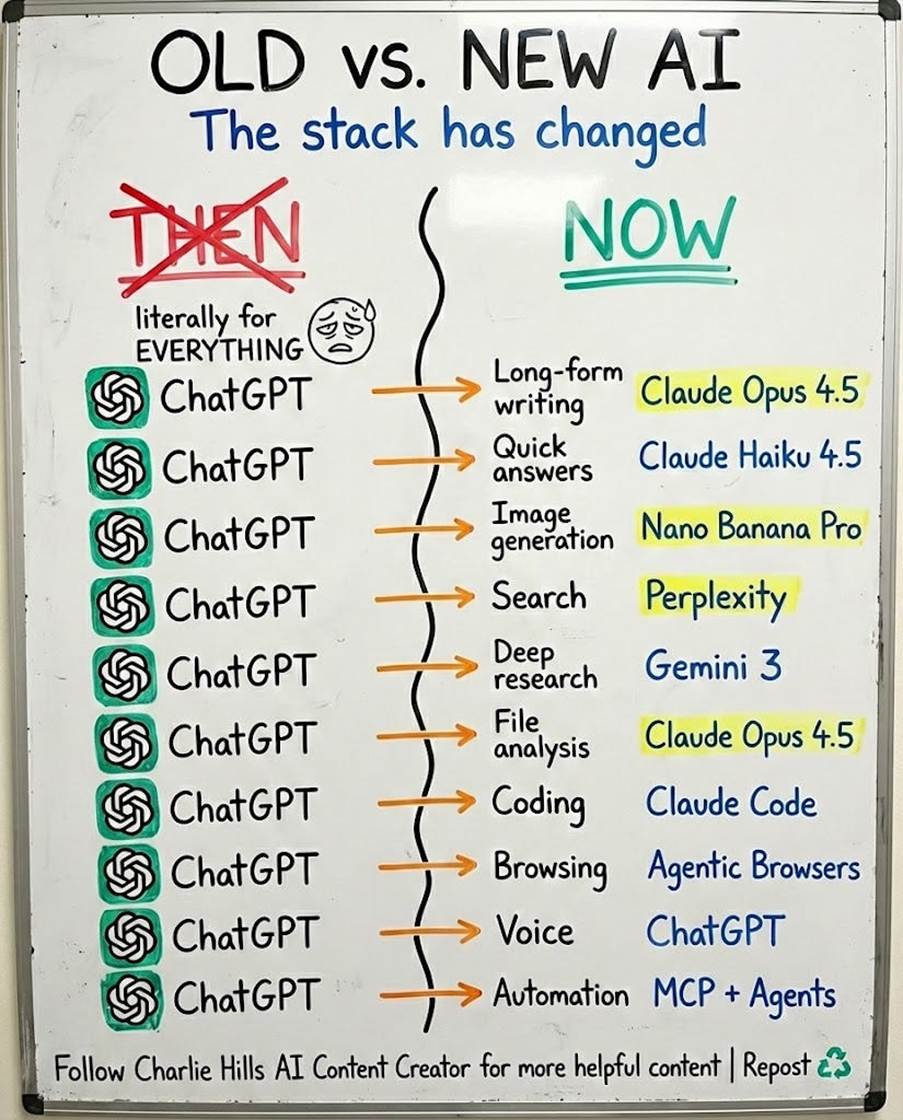
Hands up if you know what Nano Banana Pro is!
5. And, finally, as a bit of light relief after all that serious stuff, what some people think is the best Monty Python sketch ever https://youtu.be/T70-HTlKRXo I still have my doubts about how well Monty Python humour travels, though!


 Roy Cross's Blog