Blog version: https://roycross.blog/
1. Richard Watson Todd writes an enjoyable and enjoyably opinionated blog called The Grumpy Old Academic https://grumpy.hcommons.org/ He’s only that grumpy in real life with people who submit the articles they’ve promised him very late, though.
The Grumpy Old Academic is a personal opinion blog focusing on issues in research dissemination, especially in applied linguistics, the field in which I do most of my research. As I approach the end of my career and look back on the changes in the last 30 years, it’s a mixed bag. But as a grumpy old academic, I feel obliged to engage in nostalgia and highlight what we’ve lost and what used to be better in the glory days of my early research career, always hoping that my reminiscences provoke debate.
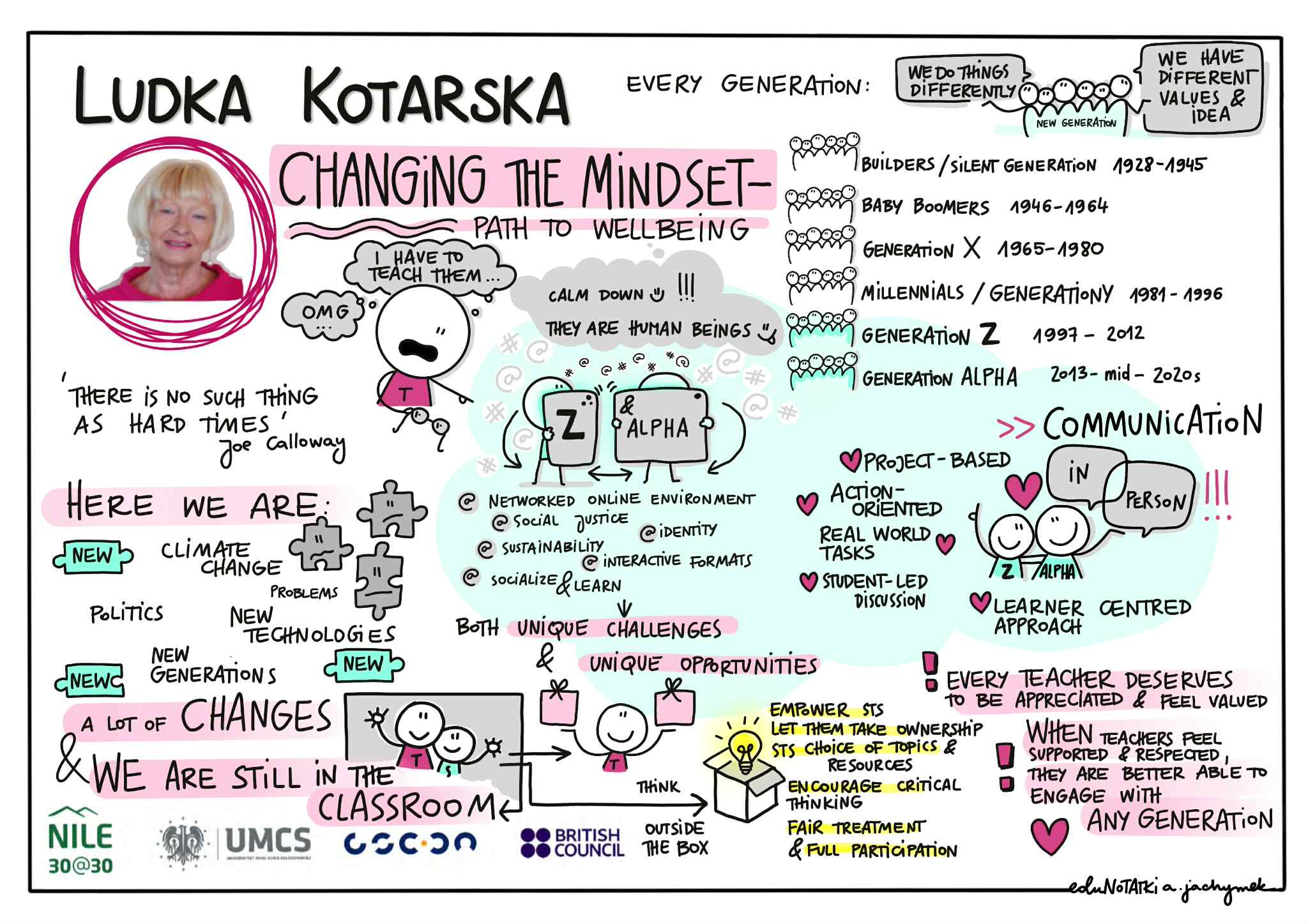
2. The Polish NILE 30@30 event took place in Lublin last Saturday, organised by Malgosia Tetiurka. Excellent ‘sketch summaries’ were made of four of the sessions – those given by Luda Kotarska, Magdalena Sowa (in Polish), Jamie Keddie & Russell Stannard – by Agnieszka Jachymek from eduNOTATKI which I reckon make sense even if you weren’t there (maybe not the Polish one). JPGs below. Ludka’s includes a useful guide to generation nomenclature!
3. An interesting recent piece on The limits of AI in social change by Gautam John on the India Development Review (IDR) website exploring the trade-off between AI efficiency and the human alternative https://idronline.org/article/technology/the-limits-of-ai-in-social-change/
More actors—from grant making to service delivery—are exploring the use of AI. However, the excitement around scale and efficiency often overshadows a critical question: What does it mean to bring machine-generated abstraction into systems built on trust, context, and relationship?
In systems of social change, we grapple with an enduring tension: connection versus abstraction. Connection is slow, human, and relational. It thrives on trust, listening, and collaboration. Abstraction, on the other hand, simplifies complexity into patterns, insights, and models. It is fast, scalable, and efficient. Both serve a purpose, but they pull in opposite directions.
4. Here’s the slides from Nik Peachey’s recent webinar, AI for Critical Thinking https://view.genially.com/68a59e52b7ec5c7d0c447f08
One of the most common criticisms of generative AI concerns its potential negative impact on students’ critical thinking skills. However, this perspective is not shared by everyone. Some educators have found that, when used thoughtfully, AI can actually enhance opportunities for critical thinking rather than diminish them. Like any tool, its impact depends on how it is applied — it can either foster meaningful learning experiences or undermine them. This webinar will present a range of practical approaches to using generative AI in ways that support the development of critical thinking and reflection skills — both for educators and for their students. Participants are encouraged to attend with an open mind and a willingness to engage critically.
5. And, finally and not at all breathlessly, Dizzy Gillespie’s cheeks. Watch out for them in this video of his biggest hit, Manteca, composed in collaboration with Cuban percussionist and composer Chano Pozo https://youtu.be/A5tRGMHfKrE


 Roy Cross's Blog